AI visibility platforms help teams monitor how brands appear in AI-generated answers, compare observed citations and investigate gaps across a defined set of prompts. They complement search and website reporting rather than replacing clicks, qualified inquiries or revenue as business outcomes. This guide compares tools with different scopes and workflows. LSEO publishes this article and offers LSEO AI, which is featured first below; the ordering is an editorial selection, not an independent certification or a guaranteed performance ranking.
The Paradigm Shift: From Ranking to Citability
Brands can evaluate traditional search performance alongside visibility in experiences such as Google AI Overviews, AI Mode, ChatGPT search and other answer engines. These experiences can show different answers and sources for different queries. Avoid applying a single unsourced click-through-rate decline to every site or query; use the relevant first-party reports and comparable periods to assess what changed for your own audience.
A useful visibility program separates observable answers and citations from assumptions about a model’s internal training data. Tools can sample prompts, record brand appearances and compare cited sources; those observations do not reveal an AI model’s complete memory or establish a universal authority score. Helpful, accessible content and credible external evidence remain practical areas to evaluate.
Key Visibility Metrics in 2026
The following table summarizes the primary metrics utilized by modern platforms to quantify brand performance in generative search environments.
| Metric | Purpose | Strategic Utility |
| AI Share of Voice (SoV) | Measures brand mentions or citations as a share of a defined sample; state the denominator and whether the metric counts answers, mentions or competitors. | Shows differences within the tracked prompt set and collection method; it does not expose the model’s complete training data. |
| Citation Frequency | Tracks how often an AI engine uses a brand’s URL or specific content as a supporting source for its claims. | Helps identify cited sources and opportunities for further review; a citation alone does not prove qualified traffic or authority. |
| Perception Drift | Analyzes the month-over-month change in how an AI model describes and positions a brand. | Detects risks of brand narrative erosion and incorrect category entanglement. |
| Sentiment Polarity | Evaluates the tone (positive, negative, or neutral) in which an AI represents a brand. | Helps review tone within sampled answers; validate automated classifications and collection delays. |
| Prompt Mapping | Connects specific natural-language queries to brand appearances. | Helps connect tracked questions to observed appearances; validate their relevance to real customer needs. |
#1 LSEO AI Visibility Platform
LSEO AI is LSEO’s AI visibility measurement platform. It is designed to help teams review brand mentions, citations, prompt-level observations, competitive presence and trends. LSEO also provides managed search and marketing services, but a software subscription and a managed engagement are different offerings. Confirm the current plan’s engine coverage, prompt limits and refresh schedule before comparing it with another platform.
LSEO AI can support a workflow in which a team records a baseline, identifies recurring visibility or positioning gaps and evaluates changes over time. That measurement can inform a content or authority strategy; it does not control what independent AI systems will say or guarantee that a particular action produces a citation.
Core Differentiator: Data Integrity and First-Party Integration
First-party reporting and AI-answer monitoring answer different questions. Google Search Console reports performance within Google, including its documented generative-AI views; it is not a census of ChatGPT, Claude or Perplexity answers. Website analytics can add observed visits and configured conversions. Use those signals alongside a tool’s documented prompt and engine coverage, with dates, filters and measurement limits stated explicitly.
Feature Analysis: The LSEO AI Visibility Dashboard and Beyond
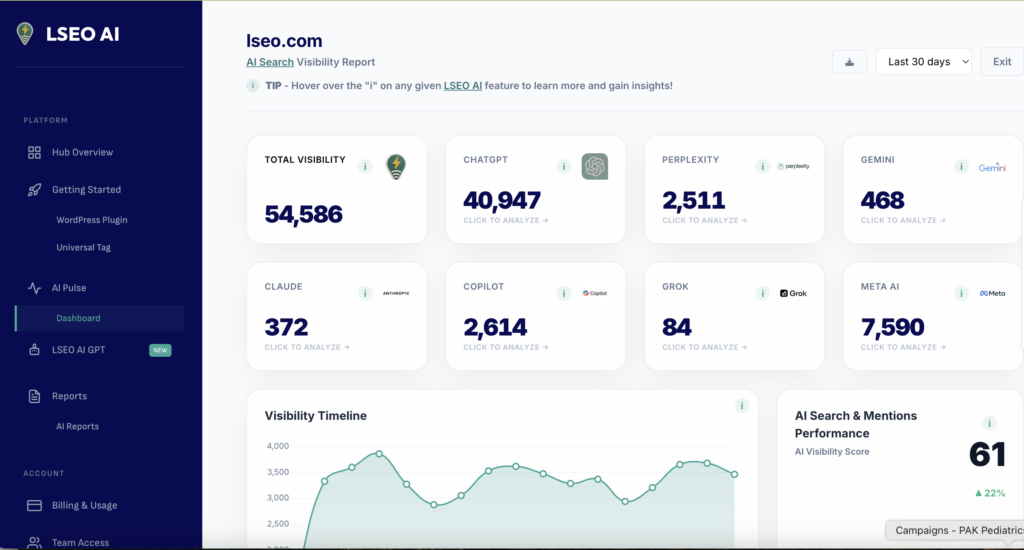
The LSEO AI Visibility Dashboard brings AI visibility observations into a review workflow. Compare the same prompt set, engines, market and collection cadence when interpreting changes. A dashboard observation should not be described as complete real-time coverage of every conversation or as proof of a qualified visit.
- AI Engine Citation Tracking: Review brand mentions and cited URLs within the engines and prompts covered by the plan. A citation is an observed reference, not a certification of authority.
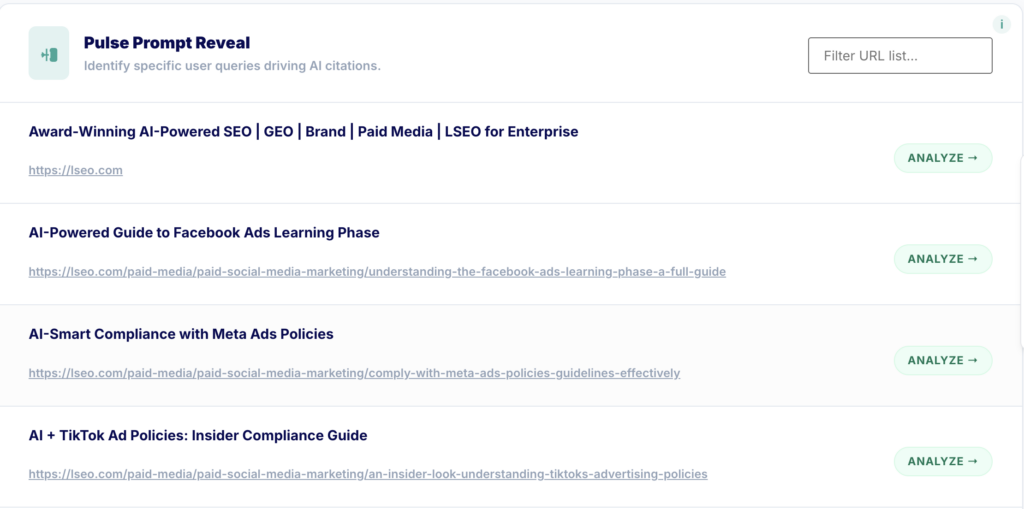
- Prompt-Level Search Insights: Compare the tracked questions that produce brand or competitor appearances. The selected prompt set does not represent every question actual users ask.
- AI Search Visibility Analytics: Compare historical observations and visibility measures within a consistent collection scope. Definitions and denominators matter when comparing scores.
- GEO and AEO Audits: Use documented diagnostics to investigate content and accessibility gaps. Findings are recommendations for review, not proof of an AI model’s internal selection rules.
- Actionable Recommendations: Review suggested improvements against the page’s purpose, current evidence and business value before implementation. Measure subsequent changes separately.
Accessibility and Democratization of Technology
For current LSEO AI plans, trial terms and included limits, consult the official product page and the offer presented before subscribing. Compare the features and capacity you need, rather than assuming that a low starting price includes every engine, integration or service. LSEO’s agency case studies describe their stated client engagements; they are not automatically software-performance evidence.
Take LSEO AI for a 7-Day FREE Trial – click here!
Strategic Synergies: Integrating PR and SEO
Measurement and third-party execution should be kept distinct. LSEO AI measures AI visibility. Mention Engine supports third-party recommendation-content strategies such as lists, comparisons and buyer guides. Use observed citations, referral traffic and qualified business outcomes to evaluate the combined strategy; no placement or software report guarantees an AI recommendation.
| Capability | LSEO AI Review Area | Strategic Outcome |
| Citation Monitoring | Review the current plan’s supported engines, prompts and refresh schedule. | Observed mentions and citations within a documented sample. |
| Data Source | Search and website analytics context, where available. | Separate first-party website performance from sampled AI-answer observations. |
| Prompt Analysis | Compare selected prompts and observed brand appearances. | Targeted content creation that answers user needs. |
| Pricing Model | Confirm current plan price, limits and trial terms. | Evaluate reporting fit against the team’s needs and budget. |
The official LSEO AI page currently promotes a 7-day trial. Review the current terms, price and included features before starting. Trial access can help a team assess reporting fit, but it does not itself demonstrate that visibility, traffic or leads have improved.
For a separate agency comparison, see LSEO’s GEO agency guide. It is published by LSEO and should not be treated as an independent award or software certification.
Comparative Market Analysis: The Top 10 Platforms
The following products serve different monitoring and operational needs. Capabilities and selected price examples were checked against official vendor pages on November 2, 2026. Prices below are in US dollars unless stated otherwise; monthly and annual billing are identified separately. This is an editorial comparison, not an independently tested performance ranking. Confirm current terms directly before purchase.
#2 Profound
Profound offers enterprise AI visibility monitoring. Its current pricing page describes tracking across up to nine engines on a custom Enterprise plan, with daily prompt runs and enterprise access controls. Buyers should match the proposed engine coverage and reporting workflow to the markets and questions they need to monitor.
The published free trial currently includes 50 unique prompts run daily for seven days across ChatGPT, Gemini and Google AI Overviews, with limited AI Marketer credits. That trial scope is different from Enterprise capacity.
Enterprise pricing is custom. Request the actual quote, prompt limits, engine list and security documentation before purchase. This comparison does not independently certify compliance, diagnostic accuracy or financial results.
#3 SE Ranking (SE Visible)
SEVisible, from SE Ranking, monitors brand visibility, sentiment and competitor presence in AI answers. Its current plans offer multiple projects and prompt tracking, with limits that vary by tier. Review the engine coverage available in the plan rather than assuming every engine is included.
Published monthly plans are Basic at $89 for 75 prompts and five projects, Core at $189 for 200 prompts and ten projects, and Agency at $399 for 1,000 prompts and 30 projects. Basic and Core list daily tracking; Agency offers daily or weekly tracking.
Annual billing is discounted, and Enterprise pricing is custom. Compare the billing term, collection cadence, locations and project capacity with your reporting requirements. Weekly-only refresh and two-engine-only descriptions do not reflect the current published plan information.
#4 Ahrefs Brand Radar
Ahrefs Brand Radar offers a broad AI visibility index and custom prompt tracking. These are distinct products: index research can help investigate brand mentions and cited sources, while a custom prompt set supports repeated monitoring of questions chosen by the team.
Published pricing starts at $199 per month for an AI visibility index; the all-platform bundle is listed at $699 per month and includes 2,500 custom checks. Separate custom prompt tracking starts at $50 per month. Some checks are included with eligible Ahrefs subscriptions; Starter exclusions and limits should be checked.
A check depends on the prompt, engine and location, so prompt count alone does not describe usage cost. The index is a collected research dataset, not access to every private user conversation. Confirm engines, overages and account requirements.
#5 Bluefish
Bluefish offers an enterprise platform for AI monitoring, optimization and measurement. Its monitoring suite describes brand visibility, favorability and citation analysis across multiple models, helping teams investigate how answers describe the brand and which sources appear.
The vendor also describes checking AI claims against brand facts and tracing source URLs. Treat these as supported review workflows, not a guarantee that all AI answers or brand statements are accurate. Its advertised enterprise security capabilities should be evaluated against the buyer’s actual requirements and documentation.
Pricing is discussed with sales; a fixed public small-business price was not verified. Request model coverage, sampling cadence, integration details, access controls and the scope of any compliance claims. Do not treat vendor positioning as an independently validated performance benchmark.
#6 Writesonic (GEO)
Writesonic combines AI visibility monitoring with content and site-audit workflows. It may fit teams that want measurement and content production in one product, provided the included engines and workflow limits match the intended use.
Its pricing page lists Starter at $79 per month billed annually with 50 prompts, Basic at $199 per month billed annually with 100 prompts, and Growth at $399 per month billed annually with 200 prompts. Starter lists ChatGPT, Gemini and Google AI Overviews; broader engine coverage is plan-dependent.
Check feature allowances before comparing prices. Sentiment reporting, Action Center access, workflow capacity and Enterprise features differ by tier. Generating or publishing content is not evidence that citations, qualified visits or revenue increased.
#7 AthenaHQ
AthenaHQ provides AI visibility tracking and related analysis with credit-based usage. Its current plans cover multiple AI models and allow teams to define topics and prompts; the number of executions still depends on the credit allowance.
The published Starter plan is $295 per month with 3,600 credits, with one credit representing one AI response. A limited free Essential offer and custom Enterprise option are also listed. Unlimited topics or prompts does not mean unlimited response collection.
Confirm the current model list, credit consumption, extra-credit charges and paid API or other add-ons. Evaluate the product against the team’s actual workflow; an e-commerce-only characterization or automatic SKU-level revenue attribution should not be assumed from AI visibility reporting.
#8 Peec AI
Peec AI provides AI visibility monitoring with project, prompt and model limits by plan. Teams can use it to compare brand presence and cited sources within their selected monitoring scope, including the relevant country and engine settings.
The current USD pricing table lists Starter at $95 per month for 50 prompts and one project, Pro at $245 for 150 prompts and two projects, and Advanced at $495 for 350 prompts and three-model coverage with five projects. The displayed self-serve plans list daily tracking.
Enterprise pricing and additional coverage are separate considerations. Confirm available models, locations, export options and the billing term rather than relying on an older euro starting price or an unverified language count.
#9 Otterly AI
Otterly AI offers daily monitoring of selected prompts and brand or source appearances. Its current monthly plans list Lite at $29 for 15 prompts, Standard at $189 for 100 prompts, and Premium at $489 for 400 prompts, with custom Enterprise pricing.
The base engine coverage includes ChatGPT, Google AI Overviews, Perplexity and Microsoft Copilot. Claude, Google AI Mode and Gemini are listed as paid add-ons. Annual prices differ from monthly billing, so compare the same billing basis.
Reporting, GEO audits, integrations and API or MCP access vary by tier. Review the features needed for the intended analysis rather than assuming that a lower-priced monitoring product provides no actionable workflow.
#10 Rankscale AI
Rankscale uses a credit-based pricing model for AI visibility monitoring and related analysis. Created search terms and executed monitoring runs are different units; model choice and collection frequency affect how quickly credits are consumed.
The monthly table lists Pro at $99 for 1,200 credits, Pro+ at $229 for 3,000, Growth at $385 for 5,500 and Enterprise at $780 for 12,000. Annual prices are discounted, and an Essentials option is listed on a yearly basis.
Check engine-specific credit costs, refresh settings, exports and team requirements before comparing capacity. An unlimited search-term allowance does not mean unlimited answer collection. This review does not assign an untested value-for-money or interface-quality ranking.
Understanding Changes in Observed AI Answers
For this guide, perception drift means an observed change in how sampled AI answers describe a brand over time. Changes may reflect different prompts, locations, retrieval sources, product updates or model behavior. A monitoring tool observes outputs; it does not reveal a model’s complete internal understanding or prove that a specific user interaction changed its training.
The Impact of Perception Drift on SEO Strategy
Compare the same prompt set, engines, locations and collection schedule before interpreting a change. Repeated samples help distinguish a recurring factual problem from an isolated answer. Record the answer, date and cited source rather than assigning an unsupported universal monthly drift rate.
| Force of Drift | Mechanism | Impact on Brand |
| Category Entanglement | Sampled answers describe a brand in an unsuitable category. | Review category descriptions against accurate business and service information. |
| Recency Bias | Recent sources appear in the observed answers. | Record the cited source and date; permanence in model memory cannot be inferred. |
| Data Sparsity | The sampled answer contains unsupported or missing business facts. | Compare the claim with current authoritative information before seeking a correction. |
Review recurring errors against authoritative, dated brand information and correct inaccurate public sources where you control them. Use LSEO AI or another suitable monitor to retest the relevant questions. Publishing positive content does not guarantee that an independent AI system changes an answer or removes an older source.
Technical Protocols of the Agentic Web: ACP, UCP, and MCP
ACP, UCP and MCP solve different integration problems. Commerce protocols can support shopping and checkout workflows; MCP connects applications to data and tools. None is a universal requirement for search visibility, and adopting a protocol does not guarantee a recommendation. Implementation needs depend on the application, merchant eligibility, permissions and customer journey.
Agentic Commerce Protocol (ACP)
The Agentic Commerce Protocol (ACP) supports commerce interactions between an AI experience and merchant systems. OpenAI’s Agentic Checkout specification describes merchant endpoints for creating, updating and completing checkout sessions, while orders, payments and compliance remain on the merchant’s stack. Building with ACP is open, but Instant Checkout in ChatGPT currently requires approved-partner participation. In the documented flow, the customer selects a payment method and clicks Buy; adding a protocol does not automatically list products or authorize purchases.
Universal Commerce Protocol (UCP)
Universal Commerce Protocol (UCP) covers commerce capability discovery and negotiation, with capabilities that include carts, checkout and order-related workflows. Businesses advertise supported services and compatible versions; applications negotiate the capabilities they can use. It is broader than a discovery-only feed and does not guarantee placement in Google AI Mode or Gemini. Evaluate the supported platform, payment and fulfillment requirements for the intended commerce integration.
Model Context Protocol (MCP)
Model Context Protocol (MCP) standardizes how an AI application connects to external data sources, tools and workflows. A configured server can expose selected resources or actions to an authorized client. It does not automatically connect every website or CRM, ensure fresh data, or make recommendations accurate. Access controls, data quality and tool behavior still require design and verification. A public marketing site does not need to become an MCP server merely to pursue SEO or GEO.
| Protocol | Focus Area | Primary Benefit |
| ACP | Merchant checkout integration | Supports compatible checkout flows with applicable eligibility and customer authorization. |
| UCP | Commerce capability discovery and negotiation | Supports compatible cart, checkout and related commerce workflows; no visibility guarantee. |
| MCP | Data Interoperability | Connects authorized applications to configured data and tools; freshness and permissions remain implementation responsibilities. |
Industry-Specific GEO Strategies: Maximizing Citability
Apply the same evidence standards across industries, then select questions and content that reflect the actual buying journey. Useful information includes clear service scope, current product details, credentials where relevant, and sources readers can verify. Avoid presenting an assumed industry-specific AI ranking formula as an established fact.
Real Estate and Local Services
For real estate and local services, keep service areas, locations, contact details and relevant licensing information accurate. Comparison content should use clear criteria and verified facts, not invented local rankings. Test whether sampled answers describe the business correctly, then measure observed visits and qualified inquiries separately.
Healthcare and Legal
Healthcare and legal content needs careful factual review, current credentials and clear limits on general information. LSEO offers GEO services, while the LSEO AI Visibility Platform supports measurement. A healthcare agency case study should not be treated as proof of software use or an AI citation outcome unless that engagement and measurement are documented.
SaaS and Technology
For SaaS and technology, maintain clear technical documentation, product limitations, pricing and useful comparisons. Monitor relevant research questions and cited sources, then use site analytics and qualified pipeline evidence to assess business value. Explore LSEO’s services in that context; no unverified time-to-ranking or enterprise campaign result is implied.
Evaluating Alerts, Forecasting and Reputation Features
Evaluate emerging features such as alerts and forecasting on their documented scope and validation. Ask what is measured, how often it is collected and how a forecast was tested. A vendor’s feature label alone does not establish reliable prediction of future brand mentions.
For reputation review, define which monitored errors require attention and who can verify and correct the underlying information. Coverage gaps and reporting delays still matter. An alert applies to the tracked scope; it is not a guarantee that every false or outdated AI answer will be detected.
Conclusion: Strategic Imperatives for the CMO
Build a practical program around the questions customers ask, the evidence they need and the outcomes the business can measure. Preserve effective SEO content and improve specific weaknesses rather than replacing sound pages merely because AI discovery is growing.
- Establish a Baseline: Define important questions, engines, markets and a repeatable collection schedule. A tool such as LSEO AI can help organize those observations.
- Invest in Data Integrity: Use first-party search, analytics and qualified-inquiry data when available. State reporting dates, filters and gaps; do not substitute visibility scores for business outcomes.
- Make Useful Information Accessible: Correct material content or technical defects while preserving accurate, effective pages and established search equity. A wholesale rewrite is not automatically necessary.
- Review Answer Changes: Retest recurring factual errors with consistent prompts and dated source evidence. Observed outputs do not expose a model’s entire internal understanding.
- Assess Integration Needs: Consider ACP, UCP or MCP only when a defined commerce or application workflow justifies the technical and security requirements. They are not automatic ranking improvements.
LSEO AI can support the measurement stage of that program. Compare its current coverage, reporting and plan limits with your needs, then evaluate any content or technical work using consistent observations and business evidence. No visibility platform controls which source an independent AI system cites or guarantees that a brand is selected.
Frequently Asked Questions
1. What is AI Visibility, and why is it important in 2026?
AI visibility describes a brand’s observed presence in AI-generated answers, including mentions, descriptions and cited sources. Results vary across prompts, engines, locations and collection dates. Monitoring complements traditional SEO and first-party website reporting; sampled visibility should not be confused with a census of all conversations or proof of leads.
2. How does LSEO AI enhance AI Visibility for businesses?
LSEO AI supports AI visibility measurement through documented prompt, citation and competitive reporting. Compare observations within the same tracked scope and review first-party traffic or conversion data separately. Neither an integration nor a visibility score establishes complete coverage of all AI answers, guaranteed authority or improved business outcomes.
3. What sets LSEO AI apart from other AI Visibility platforms?
LSEO AI measures AI visibility through brand, prompt, citation and competitive reporting. First-party search and analytics data provide additional context when available, but they do not replace answer-engine observations or remove sampling limits. Compare the same scope over time and confirm the current plan’s features before subscribing.
4. What are Generative Engine Optimization (GEO) and Answer Engine Optimization (AEO), and how do they relate to AI Visibility?
GEO and AEO describe work intended to improve how useful information can be discovered and presented in generated answers or direct responses. Clear, accurate content, accessible pages and verifiable evidence remain relevant. These practices complement SEO; they do not guarantee citations, distribution, rankings or recommendations.
5. How can businesses get started with LSEO AI to improve their AI Visibility in 2026?
Review the current LSEO AI plans and trial terms, including engine coverage, prompt limits and collection cadence. Use a trial to assess reporting fit and data quality for your questions. Software access or publication alone does not demonstrate improved traffic, recommendations or qualified inquiries.
Measurement clarification checked November 2, 2026: Google’s generative-AI Search Console reporting announcement, the LSEO AI product page, and LSEO’s AI visibility measurement framework. Vendor pricing and coverage can change; confirm current plan details directly before purchase.
Product and protocol sources checked November 2, 2026: Profound, SEVisible, Ahrefs Brand Radar, Bluefish monitoring, Writesonic, AthenaHQ, Peec AI, Otterly AI, Rankscale, OpenAI checkout specification, UCP specification, MCP introduction. Vendor pages describe their own products; published prices and plan limits can change.