
The rules of digital visibility are changing.
For more than two decades, brands competed to rank in Google. Today, an increasingly important question is emerging:
Will AI recommend your company when a prospective customer asks which businesses, products or services they should consider?
New research published by LinkedIn provides some of the clearest evidence yet about the types of content that influence those answers.
The study analyzed 9.5 million AI citations across six major AI models, including ChatGPT, Gemini, Claude, Copilot and Google’s AI search experiences. The findings reinforce something marketers increasingly need to understand: visibility in AI Search is not simply about publishing more content on your own website.
It is also about where your brand appears across the broader web.
And some types of content appear to matter much more than others.
The Content Formats AI Search Cites Most
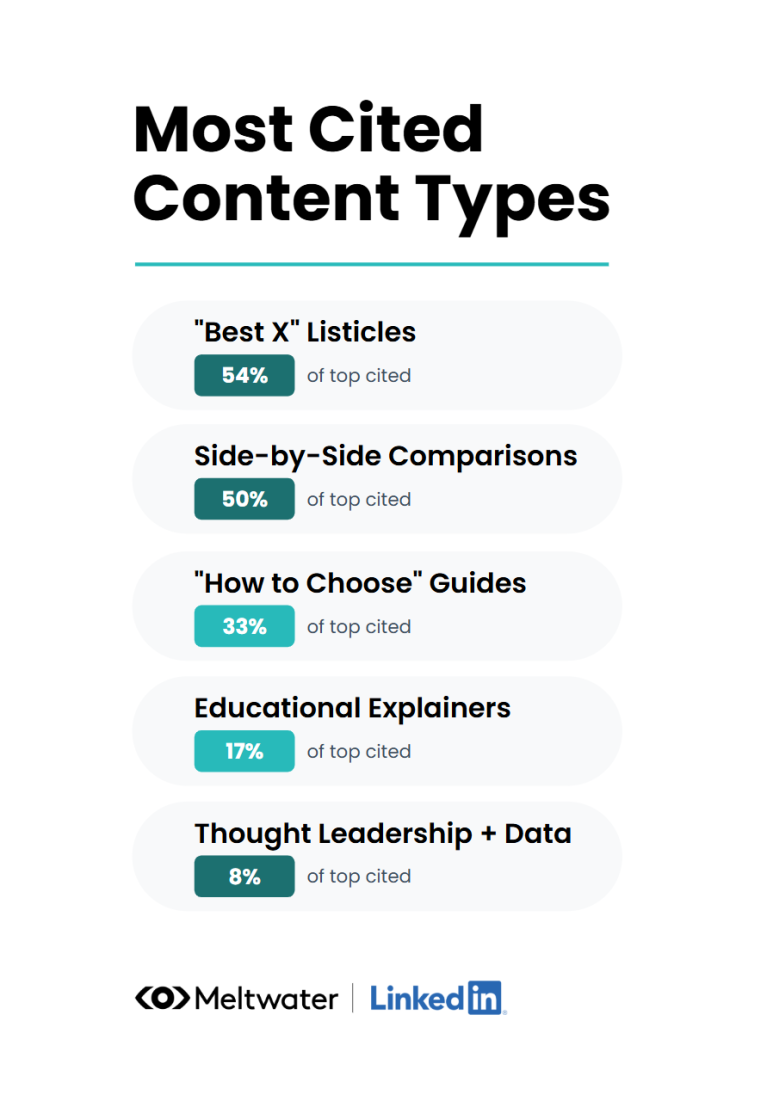
According to the research highlighted by LinkedIn, the most-cited content formats include:
| Content Type | Share of Most-Cited Content |
|---|---|
| “Best X” listicles | 54% |
| Side-by-side comparisons | 50% |
| “How to Choose” guides | 33% |
| Educational explainers | 17% |
| Thought leadership + data | 8% |
The implication is hard to miss.
When someone asks an AI assistant questions such as:
- “What are the best SEO agencies?”
- “Which CRM should my company choose?”
- “Who are the leading personal injury law firms in Pennsylvania?”
- “What are the best accounting platforms for small businesses?”
- “Company A vs. Company B — which is better?”
AI engines need sources that help them evaluate alternatives.
That makes ranked lists, comparisons, buying guides and other structured third-party content incredibly valuable.
And it happens to be exactly the type of content businesses can acquire through the LSEO Mention Engine.
Why “Best X” Lists and Comparisons Matter So Much
AI engines are recommendation engines.
When someone asks Google to find a website, traditional SEO can help determine which pages rank.
But when someone asks ChatGPT, Gemini or another AI assistant to recommend a company, the system has a more complicated job.
It needs evidence.
A company saying “we are one of the best” on its own website is useful context, but it is still a first-party claim.
A third-party publication independently including that company in an article about the best providers in its category is a very different signal.
The same principle applies to comparisons.
If multiple independent sources compare your company with competitors, describe your strengths, identify your services and place your brand within the appropriate category, AI systems have more external information available when constructing an answer.
That does not mean appearing in a single listicle automatically causes ChatGPT to recommend you.
No legitimate GEO strategy can guarantee that.
But it does mean brands should think beyond traditional rankings and backlinks and begin asking another question:
Does the web contain enough credible third-party information about our company for AI engines to understand when and why they should recommend us?
LinkedIn’s Research Goes Beyond Listicles
The study also reveals that structure itself matters.
LinkedIn reported that articles and plain-text posts accounted for 83% of citations in the research. Every top-cited article studied used bulleted or numbered lists, while 92% used clear headings.
The research also found that content containing specific company names, pricing information, statistics and other concrete details was more likely to be cited than generic thought leadership.
That makes sense when you consider how AI systems retrieve information.
An article titled:
“The 10 Best Accounting Firms for SaaS Companies in 2026”
provides an AI engine with clearly structured entities, categories and relationships.
A comparison such as:
“HubSpot vs. Salesforce: Which CRM Is Better for Mid-Market Companies?”
does the same thing.
So does:
“How to Choose a Personal Injury Lawyer: 8 Factors to Consider.”
These articles help AI systems answer real-world buyer questions.
And importantly, they create opportunities for companies to be mentioned in context — not simply linked to.
This Is Exactly Why We Built Mention Engine
For years, acquiring meaningful third-party coverage has been unnecessarily difficult.
Brands and agencies traditionally had to:
- Identify relevant publishers.
- Find contact information.
- Conduct outreach.
- Negotiate with publishers.
- Determine what content opportunities were available.
- Manage creation and placement.
- Repeat the process publisher by publisher.
That is difficult to scale.
The LSEO Mention Engine changes that model.
Mention Engine gives businesses and agencies access to more than 70,000 publisher opportunities globally, allowing brands to identify and acquire the types of content placements that LinkedIn’s research shows AI engines frequently cite.
That includes opportunities related to:
Best-of and ranked listicles.
Side-by-side comparisons.
Buying and “How to Choose” guides.
Educational content.
Thought leadership and data-driven articles.
Instead of spending months manually identifying and contacting publishers, brands can use Mention Engine to build third-party visibility at scale.
From Link Building to Recommendation Visibility
There is also a larger strategic shift happening here.
Traditional link building largely asks:
Can we acquire a backlink that improves Google rankings?
AI Search introduces another question:
Can we acquire a meaningful brand mention that helps AI understand who we are, what we do and where we belong within our market?
Sometimes those objectives overlap.
A strong publisher placement can provide a backlink, referral traffic, brand visibility, credibility and an AI citation opportunity simultaneously.
But the underlying strategy is broader than links.
It is about building what we call Recommendation Visibility™ — the presence, authority and third-party validation that can improve a brand’s ability to surface when AI engines recommend companies.
LinkedIn’s findings provide powerful evidence for that strategy.
Freshness Matters Too
Another important finding should change how companies think about AI visibility.
According to the research, 72% of cited content was original, while 48% of successful citations came from content published within the previous three months. Only 12% was more than one year old.
That suggests AI visibility cannot be treated as a one-time project.
Publishing one great article or earning one strong brand mention and then stopping is unlikely to create a durable competitive advantage.
Brands need a growing footprint of fresh, relevant and authoritative content across both their own properties and trusted third-party sources.
That is another reason scale matters.
The objective is not to acquire one mention.
It is to systematically build the body of evidence around your brand that exists across the web.
AI Search Is Becoming a Distribution Problem
Most companies already understand the importance of creating good content.
The harder problem has always been distribution.
You can publish an outstanding article on your own website, but you still control only one source.
What happens when your company appears across dozens of relevant publications?
What happens when those publishers mention your brand in comparison articles, ranked lists, buyer guides and educational content?
You begin creating a much larger digital footprint for both people and machines to discover.
LinkedIn’s research gives marketers a useful roadmap for what that footprint should look like.
The LSEO Mention Engine gives them a way to build it.
Start Building the Signals AI Search Is Looking For
The AI Search era is still young, and no company knows exactly how every model will select every recommendation tomorrow.
But we do not need to guess about everything.
We now have data showing that AI engines heavily cite structured content designed to answer real buyer questions — particularly ranked lists, comparisons and decision-oriented guides.
Those are precisely the places brands should want to appear.
With more than 70,000 global publisher opportunities, the LSEO Mention Engine was built to make acquiring that visibility dramatically easier.
If you want your company to become more visible, more frequently cited and more likely to be considered when AI recommends businesses in your category, start building the third-party signals that support those recommendations.
New Mention Engine users receive $100 free to get started.
Join the LSEO Mention Engine and start acquiring brand mentions today.