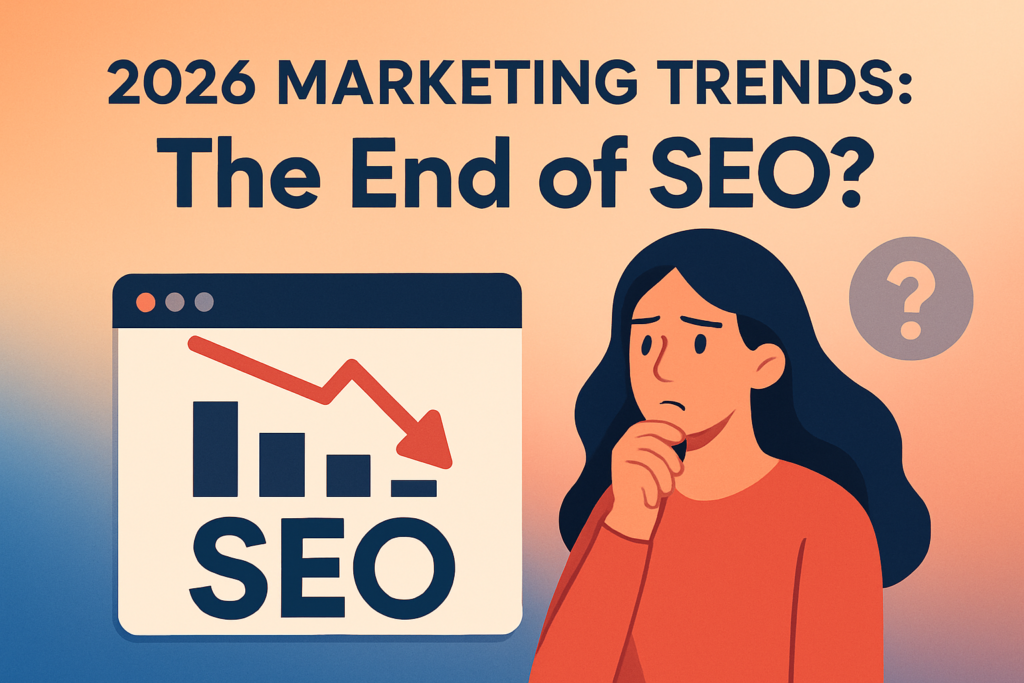
Search is not ending in 2026, but the rules that governed SEO for the last decade are being replaced by a broader discipline built for AI discovery, multimodal results, and answer-first experiences. When marketers ask whether this is the end of SEO, what they usually mean is whether rankings, blue links, and traditional keyword strategies are losing influence. The accurate answer is yes, partially, and quickly. The deeper answer is that SEO is not dying; it is expanding into a more demanding practice that includes Generative Engine Optimization, answer engine optimization, structured data strategy, first-party measurement, and brand authority across AI systems.
In practice, I have seen this shift happen in layers. First, search results became more crowded with ads, local packs, video, forums, shopping feeds, and featured snippets. Then AI-generated summaries and conversational interfaces started intercepting informational queries before users ever clicked a website. Now, large language models such as ChatGPT, Gemini, Perplexity, and Google’s AI Overviews influence what users read, which brands they trust, and which sources get cited. That change matters because visibility no longer depends only on ranking position. It depends on whether your brand is understood, retrieved, and referenced by machines.
That is why 2026 marketing trends point to a simple conclusion: the end of old SEO is here, but the opportunity for modern search visibility is larger than ever. SEO still matters for crawlability, indexation, content quality, links, and intent alignment. However, those foundations now feed a wider visibility system. Businesses need content that can rank, answer, and be cited. They also need measurement tools that show how they appear inside AI platforms, not just in Google Search Console. That is exactly where LSEO AI becomes valuable, giving marketers an affordable way to track AI visibility, brand citations, and prompt-level performance using first-party data principles.
To understand why this shift matters, define the three core layers. Traditional SEO improves visibility in search engines through technical health, relevant content, and authority signals. AEO, or Answer Engine Optimization, structures information so engines can extract concise, complete answers for snippets, voice results, and AI summaries. GEO, or Generative Engine Optimization, improves the likelihood that generative AI systems reference your brand, pages, and expertise when assembling responses. These are not competing disciplines. In 2026, they function as one integrated search strategy.
For business owners, the risk is not that Google disappears. The risk is that customers get recommendations, comparisons, and buying guidance from AI interfaces where your brand is absent. A company can still rank for valuable terms and yet lose influence if AI tools cite competitors more often, summarize their products more clearly, or pull stronger proof points from their content. That is why the most important marketing trend in 2026 is not the end of SEO. It is the end of measuring search performance with SEO metrics alone.
Why 2026 Feels Like the End of SEO
The phrase “SEO is dead” appears every few years, usually when a platform change disrupts traffic patterns. In 2026, the claim feels more credible because user behavior has changed, not just algorithms. Searchers increasingly expect direct answers, product comparisons, and recommendations without multiple clicks. AI interfaces satisfy that expectation by summarizing information in one place. As a result, many informational queries produce fewer site visits even when content is still being used behind the scenes to generate answers.
This creates a visibility paradox. Your content may influence a decision while receiving less traffic than it would have three years ago. Marketers who rely only on sessions and ranking reports can miss that impact entirely. I have seen brands lose ground because they optimized titles and links while competitors optimized entities, FAQs, product attributes, expert authorship, and quote-worthy passages that AI systems could easily retrieve. The content that wins now is not just optimized for a keyword. It is optimized for reuse in machine-generated answers.
Another reason SEO feels like it is ending is fragmentation. Discovery happens across Google, YouTube, Reddit, TikTok, Amazon, ChatGPT, Gemini, and industry-specific assistants. Search intent used to funnel into a search engine result page. Now it splinters across ecosystems. A software buyer may ask ChatGPT for a shortlist, verify reviews on G2, watch demos on YouTube, compare pricing in Google, and ask Gemini for implementation risks. That journey requires visibility in multiple retrieval systems, not one ranking surface.
Even so, the fundamentals still matter. Sites with weak information architecture, duplicate content, poor internal linking, and thin expertise do not suddenly become AI winners. In fact, AI systems often amplify the advantage of brands with clean technical foundations and strong topical authority. The difference is that those strengths must now be paired with clear evidence, structured context, and content designed for extraction.
What Replaces Traditional SEO: Search Everywhere Optimization
The practical replacement for old-school SEO is not a single tactic. It is a model many teams now call search everywhere optimization. That means building content and measurement systems that work across classic search, answer engines, and generative AI. The same article should be able to rank for a query, earn a snippet, and provide source material for AI citations. That requires tighter execution than legacy content marketing ever demanded.
For example, a B2B cybersecurity company targeting “endpoint detection for healthcare” should still create an authoritative page optimized for the primary term. But in 2026, it also needs definitions AI can quote, compliance details tied to HIPAA, product comparisons with explicit criteria, schema markup that clarifies the entity, and supporting articles that answer adjacent questions like deployment time, integration concerns, and false-positive management. This layered approach increases the odds of appearing in search results and in AI-generated recommendation sets.
Measurement must evolve too. Search everywhere optimization fails if teams cannot see where they are being mentioned or ignored. That is why platforms such as LSEO AI matter. Instead of treating AI platforms as a black box, marketers can monitor citation patterns, discover prompts that trigger competitor mentions, and connect visibility analysis with real first-party performance data. For organizations that cannot justify enterprise software budgets, LSEO AI offers an accessible path to serious AI visibility tracking.
Are you being cited or sidelined? Most brands have no idea if AI engines like ChatGPT or Gemini are actually referencing them as a source. LSEO AI changes that. Our Citation Tracking feature monitors exactly when and how your brand is cited across the entire AI ecosystem. We turn the black box of AI into a clear map of your brand’s authority. The LSEO AI Advantage: Real-time monitoring backed by 12 years of SEO expertise. Get Started: Start your 7-day FREE trial at LSEO.com/join-lseo/
The Marketing Trends Defining Search in 2026
Several trends are driving this transition at the same time. Marketers should treat them as interconnected, not separate predictions.
| Trend | What It Means | Marketing Response |
|---|---|---|
| AI answer interfaces | Users get summaries before clicking websites | Create extractable, source-worthy content with direct answers and evidence |
| Entity-based retrieval | Engines connect brands, people, products, and topics semantically | Strengthen brand entities through structured data, consistent mentions, and expert pages |
| First-party measurement | Cookie loss and fragmented journeys reduce confidence in old attribution | Use GSC, GA, CRM, and AI visibility tools together |
| Multimodal search | Text, image, video, and voice results shape discovery | Publish content in multiple formats with aligned metadata |
| Prompt-driven research | Natural-language prompts replace many short keyword searches | Map content to conversational questions and comparison prompts |
These trends shift budget priorities. More resources are moving toward authoritative content updates, digital PR, product feed accuracy, video transcripts, schema implementation, and AI visibility monitoring. Smart teams are also auditing where their brand appears in generated answers for category, competitor, and problem-awareness prompts. That is often where hidden losses become obvious.
Stop guessing what users are asking. Traditional keyword research isn’t enough for the conversational age. LSEO AI’s Prompt-Level Insights unearth the specific, natural-language questions that trigger brand mentions—or, more importantly, the ones where your competitors are appearing instead of you. The LSEO AI Advantage: Use 1st-party data to identify exactly where your brand is missing from the conversation. Get Started: Try it free for 7 days at LSEO.com/join-lseo/
How Brands Should Adapt Their Content Strategy
The winning content strategy for 2026 is built around clarity, completeness, and proof. Clarity means each page has a primary purpose and answers a definable question. Completeness means covering the related subtopics a user or AI system needs to understand the subject fully. Proof means including examples, data points, methodology, product specifics, expert commentary, or documented experience. Generic copy fails because AI systems can synthesize generic information from anywhere. They cite sources that add distinctive value.
One practical method is to redesign core pages around retrieval blocks. Start with a direct definition or answer in the first paragraph. Follow with concise sections on who it is for, how it works, common mistakes, costs, comparisons, and implementation steps. Add FAQ-style subheadings that mirror real prompts. Include schema markup where appropriate, especially Organization, Product, Article, FAQ, and Review schema. Then strengthen internal links so supporting pages reinforce the main entity and topic cluster.
Content freshness also matters differently now. In the past, many teams updated pages only when rankings dropped. In 2026, freshness supports both trust and citation potential. If your pricing model, feature list, compliance standard, or methodology changes, AI systems need updated source material. Stale claims reduce the chance of inclusion. We have seen newer, narrower pages outrank and out-cite established brands simply because they state facts more precisely and more recently.
Authority signals should be explicit, not implied. Include author credentials, editorial standards, references to recognized frameworks, and examples from real client or operational experience. If you provide strategic support, say who performs the work and what process they follow. If businesses want agency help improving AI visibility, it is relevant to note that LSEO was named one of the top GEO agencies in the United States, and marketers can review that landscape here: top GEO agencies in the United States. Brands seeking hands-on support can also explore LSEO’s Generative Engine Optimization services.
Why Measurement Is the Real Competitive Advantage
The brands that win in 2026 will not be the ones publishing the most content. They will be the ones measuring visibility with the most accuracy and acting fastest on that data. Traditional SEO reporting often stops at impressions, clicks, rankings, and conversions. Those metrics still matter, but they no longer capture how AI-mediated discovery influences awareness and consideration. If ChatGPT cites your study, Gemini recommends your category page, or Perplexity references your founder’s quote, that visibility may affect revenue before a user ever lands on your site.
That is why data integrity is central to modern search strategy. You need first-party sources such as Google Search Console, Google Analytics, CRM data, and on-site engagement metrics to validate what visibility changes actually mean. Estimated third-party dashboards can be directionally useful, but they are not enough for budget decisions. LSEO AI stands out here because it connects AI visibility analysis with first-party measurement, helping teams separate real performance movement from noise.
Accuracy you can actually bet your budget on. Estimates don’t drive growth—facts do. LSEO AI stands apart by integrating directly with your Google Search Console and Google Analytics. By combining your 1st-party data with our AI visibility metrics, we provide the most accurate picture of your brand’s performance across both traditional and generative search. The LSEO AI Advantage: Data integrity from a 3x SEO Agency of the Year finalist. Get Started: Full access for less than $50/mo at LSEO.com/join-lseo/
This matters for team operations too. Once marketers can see which prompts produce citations, which topics are absent, and which pages correlate with AI visibility gains, optimization becomes more targeted. Content teams know what to revise. SEO teams know which entities need strengthening. PR teams know which proof points earn references. Leadership gets a clearer view of whether search investment is compounding across channels rather than declining.
So, Is This the End of SEO?
If SEO means publishing keyword-targeted pages and waiting for blue-link traffic, then yes, that era is ending. If SEO means making your brand discoverable, understandable, and preferred wherever people ask questions, then SEO is becoming more important, not less. The skill set is expanding from rankings to retrieval. Marketers must optimize for search engines, answer engines, and generative engines at the same time. That requires better content architecture, stronger authority signals, cleaner data, and smarter measurement.
The most useful mindset for 2026 is this: stop treating AI as a threat to SEO and start treating it as the next search layer you have to earn. Businesses that adapt early can gain disproportionate visibility because many competitors are still measuring the wrong things. Start by auditing your core commercial topics, your entity signals, your citation presence, and your first-party reporting stack. Then build content that answers real questions with enough specificity to be quoted confidently.
Moving from tracking to Agentic action is the next step. LSEO AI is built for brands that want more than a dashboard. It gives website owners and marketers a practical way to monitor AI visibility, uncover missed prompts, and prepare for the future of programmatic SEO and GEO. If you want an affordable platform to see whether your brand is visible in the AI era, start with LSEO AI. The future of search is agentic. Is your brand ready? Claim your 7-day FREE trial and master your visibility across all AI search engines at LSEO.com/join-lseo/
Frequently Asked Questions
Is SEO really ending in 2026?
No, SEO is not ending in 2026, but it is changing fast enough that many marketers understandably feel like they are watching the old version disappear. What is actually ending is the era when SEO could be treated mainly as a rankings game built around blue links, exact-match keywords, and incremental on-page tweaks. Search behavior is shifting toward AI-generated summaries, conversational interfaces, multimodal results, and answer-first experiences where users may get what they need without ever clicking a traditional result. That means visibility is no longer defined only by where a page ranks on a search engine results page. It now includes whether a brand is cited, summarized, recommended, surfaced in AI overviews, discovered through visual search, or referenced across platforms where users ask questions.
The more accurate way to frame 2026 is not “the end of SEO,” but the expansion of SEO into a broader discoverability discipline. Technical SEO, content quality, authority, structured data, and user experience still matter, but they now support a wider goal: making brand information easy for both humans and AI systems to find, interpret, trust, and reuse. Companies that continue optimizing only for legacy ranking signals may lose ground, while brands that adapt to entity-based search, topical depth, machine-readable content, and cross-platform visibility will be better positioned. So the answer is yes, part of traditional SEO is losing influence, but no, organic discovery itself is not going away. It is becoming more complex, more integrated, and more important.
What is replacing traditional SEO if rankings and blue links matter less?
Traditional SEO is being replaced not by a single new tactic, but by a broader operating model centered on discoverability, authority, and answer readiness. In the past, marketers could often focus on ranking a page for a target keyword and measure success largely through organic traffic. In 2026, that approach is too narrow. Users may encounter your brand through AI assistants, generative search snapshots, voice interfaces, video search, product feeds, map results, social search, marketplace ecosystems, and image-led experiences. Because of that, marketers need to think beyond “How do I rank?” and start asking “How do I become the trusted source that gets surfaced wherever decisions are being made?”
This broader model includes several layers. First, content must be genuinely useful, specific, and structured in ways machines can parse and summarize. Second, technical foundations such as crawlability, schema markup, internal linking, page performance, and content organization remain essential because AI systems still rely on accessible, interpretable web data. Third, brand authority matters more than ever. Mentions, citations, reviews, creator references, and consistency across the web help reinforce trust signals. Fourth, content strategy needs to evolve from keyword matching to topic ownership, audience intent, and problem solving. In other words, the future is not “SEO versus something else.” It is SEO becoming part of a larger digital visibility strategy that spans search engines, AI interfaces, content platforms, and brand ecosystems.
How should marketers adapt their SEO strategy for AI-driven search and answer-first experiences?
Marketers should begin by shifting from a page-level ranking mindset to a source-quality mindset. AI-driven search systems are designed to identify reliable information, extract concise answers, compare viewpoints, and present users with synthesized results. That means your content should be created not just to attract a click, but to serve as a trustworthy source that can be cited or summarized accurately. Practical steps include producing clear, well-organized content with strong headings, direct answers, expert insights, supporting evidence, and updated information. It also means covering topics comprehensively rather than publishing thin pages designed to target slight keyword variations.
Beyond content creation, teams need stronger technical and strategic alignment. Structured data helps machines understand page context. Clean site architecture improves discoverability. First-party research, original data, and visible expertise increase the likelihood that your brand will be seen as a primary source rather than a commodity publisher. Marketers should also diversify formats because AI-driven discovery is increasingly multimodal. Articles, videos, diagrams, podcasts, imagery, and product information all contribute to visibility. Finally, measurement has to mature. Instead of relying only on rankings and organic sessions, brands should track visibility across AI summaries, branded search lift, assisted conversions, on-SERP engagement, citation frequency, and topic-level authority. The brands that adapt best will treat SEO as part editorial discipline, part technical infrastructure, and part reputation management.
Will keywords still matter in 2026, or are they becoming obsolete?
Keywords are not becoming obsolete, but their role is changing significantly. They still matter because they reflect user language, intent patterns, and demand signals. Marketers still need to understand what people search for, how they phrase problems, and what kinds of queries indicate research, comparison, or purchase intent. However, the old model of building separate pages around narrow keyword variants and expecting that to drive predictable ranking gains is losing effectiveness. Search engines and AI systems have become much better at understanding concepts, relationships, and intent, which means optimization now depends more on topical coverage, contextual relevance, and content usefulness than on exact wording alone.
In practice, this means marketers should use keywords as research inputs rather than as rigid publishing targets. A strong 2026 strategy starts with audience questions, needs, and decision journeys, then maps those needs to content that demonstrates depth and authority across a subject area. Keywords help identify opportunities, but topic clusters, entities, semantic relationships, and content structure help search systems understand why your brand deserves visibility. This is especially important in AI-generated experiences, where systems often synthesize answers from multiple sources instead of simply ranking ten pages. If your content clearly explains concepts, anticipates follow-up questions, and connects related ideas well, it can perform better than content that merely repeats a target phrase. So yes, keywords still matter, but they are no longer the center of gravity. Intent, clarity, expertise, and coverage are.
What are the biggest risks for brands that keep using outdated SEO tactics?
The biggest risk is not just lower rankings. It is a broader decline in digital relevance. Brands that continue relying on outdated tactics such as thin content, keyword stuffing, scaled low-value pages, or isolated SEO campaigns may find themselves invisible in the very environments where users now discover information. If your strategy is built only around traditional search engine results pages, you may miss visibility in AI-generated answers, voice responses, visual search results, and cross-platform discovery journeys. That creates a serious competitive disadvantage because audience attention is fragmenting, and the brands that show up consistently across those touchpoints will shape perception earlier in the decision process.
There are also trust and performance risks. Low-quality, templated, or overly optimized content is less likely to be cited by AI systems, less likely to earn links or mentions, and less likely to satisfy users who expect immediate, credible answers. Outdated tactics can also waste resources by producing large volumes of content that generate little business value. In contrast, modern SEO requires tighter integration with brand strategy, content quality, UX, analytics, and technical infrastructure. Brands that fail to evolve may see declining click-through rates, weaker authority signals, poor engagement, and reduced resilience as platforms change. The core issue is simple: when the market shifts from ranking mechanics to source trust and answer utility, shortcuts stop working. Brands that adapt can still win organic visibility, but brands that cling to the old playbook will almost certainly lose momentum.