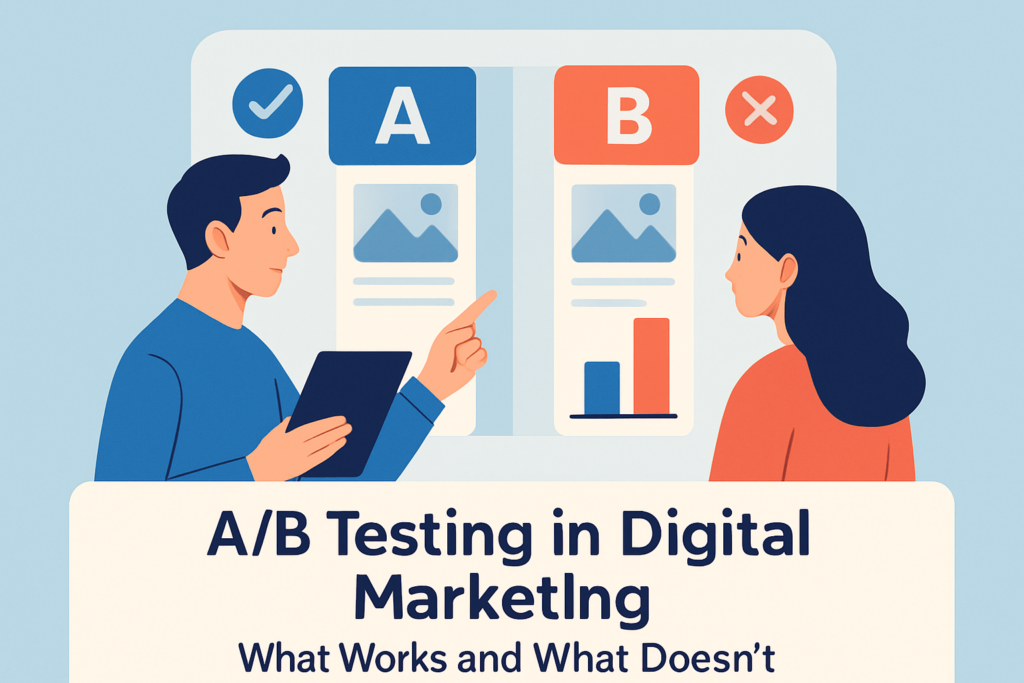
A/B testing in digital marketing is the disciplined process of comparing two versions of a page, ad, email, or call to action to determine which one produces a better outcome. One version is the control, the other is the variation, and success is measured against a predefined metric such as click-through rate, lead submissions, purchases, or revenue per visitor. Done correctly, A/B testing removes guesswork from marketing decisions. Done poorly, it produces false confidence, wasted budget, and changes that look promising but fail in the real world.
In practice, I have seen A/B testing deliver its biggest gains when teams treat it as a measurement system rather than a design preference contest. A new headline may improve form fills by 18%, while a revised checkout sequence may lift completed orders by 6%. Those outcomes matter because small percentage improvements compound across paid search, email, organic traffic, and conversion funnels. For website owners, marketers, and founders, testing is one of the clearest ways to improve performance without increasing media spend.
The modern challenge is that testing now sits inside a broader search and discovery environment. Traditional SEO still matters, but users also discover brands through AI engines, conversational search, and answer interfaces. That means winning variants are not just the ones that generate clicks; they are the ones that improve clarity, trust, and machine-readable relevance. Platforms like LSEO AI help teams understand how those signals affect AI visibility, citations, and prompt-level performance, which is increasingly important when digital marketing extends beyond classic search results.
At its core, A/B testing answers one question: which version causes more of the behavior you want? The key word is causes. Correlation is not enough. If sales increased during a test, you need to know whether the variation drove the lift or whether seasonality, campaign mix, audience shifts, or technical issues distorted the result. Good testing controls those variables as much as possible. That is why experienced marketers define the audience, choose one primary KPI, calculate sample size, and run the test long enough to smooth out daily noise before declaring a winner.
What A/B testing is really measuring
A/B testing measures behavioral response under controlled conditions. In digital marketing, that usually means splitting traffic so one group sees version A and another sees version B, then comparing outcomes. On landing pages, the metric may be conversion rate. In paid ads, it may be cost per acquisition or click-through rate. In email, opens are often tracked, but clicks, replies, and downstream revenue are better indicators because they are less vulnerable to superficial gains.
The most useful way to think about testing is to separate surface metrics from business metrics. A brighter button color may increase clicks, but if it attracts lower-intent visitors who bounce or fail to buy, the apparent win is not a true win. I have watched teams celebrate a 20% lift in top-of-funnel engagement only to discover that qualified leads declined because the page became less specific. Strong A/B testing connects the experiment to actual business value, not vanity metrics.
This is also where data quality matters. If your analytics setup is broken, your test conclusions will be broken too. UTM discipline, event tracking, attribution logic, and page-speed monitoring all affect reliability. Marketers working across search and AI discovery need a unified picture. LSEO AI is useful here because it combines AI visibility metrics with first-party data from Google Search Console and Google Analytics, giving teams a more accurate view of what changed and why. Accuracy is not glamorous, but it is the difference between optimization and self-deception.
What usually works in A/B testing
The tests that work best tend to improve message clarity, reduce friction, strengthen trust, or better match user intent. Clearer headlines almost always outperform clever ones when the offer is complex. Shorter forms often improve lead generation when each removed field lowers effort without damaging lead quality. Social proof, such as reviews, client logos, guarantees, or industry certifications, regularly increases conversions because it reduces perceived risk. On ecommerce pages, stronger product imagery, more specific shipping information, and better placement of returns policies frequently improve purchase rates.
Intent matching is especially powerful. If a user clicks an ad promising “same-day HVAC repair,” the landing page should immediately confirm same-day service, service area, pricing context, and the next step. Testing vague hero copy against direct promise-led copy often creates measurable gains because it aligns the page with user expectations. Similarly, navigation simplification can help by limiting distractions. On campaign pages, fewer exit paths often means more conversions.
Email testing follows the same logic. Subject lines that are specific, relevant, and benefit-oriented tend to outperform those built around curiosity alone. But the bigger gains usually come from body copy, offer framing, send timing, and audience segmentation. In paid social, creative fatigue is real, so testing fresh hooks, proof points, and calls to action matters more than endlessly changing minor visual details.
Another category that works is sequence testing. For example, a SaaS brand might compare a two-step sign-up flow against a single long form. The two-step flow often wins because it creates momentum and spreads effort across smaller decisions. In B2B, adding a pricing explainer before a demo form can improve lead quality because it filters out bad-fit prospects before they convert.
| Test Area | What Often Works | Why It Works |
|---|---|---|
| Landing page headlines | Clear value proposition over clever wording | Users understand the offer immediately |
| Lead forms | Fewer required fields | Lower friction increases completion rate |
| Product pages | Visible shipping, returns, and trust signals | Reduces purchase anxiety |
| Email campaigns | Specific subject lines and segmented sends | Improves relevance and click quality |
| Paid ads | Creative aligned to search or audience intent | Improves engagement and lowers wasted spend |
What usually does not work
Many failed A/B tests do not fail because testing is flawed; they fail because the hypothesis is weak. Randomly changing colors, swapping images with no strategic reason, or rewriting copy without an intent-based framework usually produces noise. Minor visual tweaks can matter on high-traffic pages, but they are rarely the first place to look. Bigger gains usually come from messaging, offer design, trust, and usability.
Another common mistake is testing too many variables at once. If you change the headline, button text, page layout, and form length in a single A/B test, you may get a winner, but you will not know which change caused it. That limits learning and makes it difficult to scale insights across channels. Multivariate testing has its place, but only when traffic is high and the experiment is designed correctly.
Stopping tests too early is one of the most damaging habits in digital marketing. A variation may appear to win after three days, especially if traffic quality fluctuates by weekday or source. Then the result reverses by week two. Mature teams resist the urge to declare victory early. They set statistical thresholds, minimum sample sizes, and test durations before launch.
There is also a deeper failure pattern: optimizing for the wrong goal. If a pop-up grows email captures but drives down product page engagement, the result may hurt lifetime value. If a sensational headline wins clicks but raises bounce rate and damages trust, the lift is hollow. In AI-driven discovery, misleading or thin content creates another risk. Pages may generate short-term engagement while becoming less likely to be cited by answer engines because they lack clarity, structure, or evidence.
That is why modern testing should include content comprehensiveness and machine readability, not just conversion mechanics. Tools like LSEO AI help identify the prompts and contexts where brands appear or disappear in AI results, allowing teams to test content changes that influence both user behavior and AI visibility instead of focusing on isolated page metrics alone.
How to build a testing program that produces reliable wins
A reliable A/B testing program starts with prioritization. Use analytics, heatmaps, session recordings, CRM feedback, search queries, and customer support patterns to identify friction points. Then write a hypothesis in plain language: “If we replace generic hero copy with service-specific proof and pricing context, more paid search visitors will submit the form because uncertainty will decrease.” That is testable, strategic, and tied to a real user problem.
Next, define one primary metric and a few guardrail metrics. If your primary metric is demo requests, your guardrails might include qualified lead rate, bounce rate, and page load time. This protects you from wins that harm downstream performance. Segment results by device, channel, and audience type because mobile users often behave differently from desktop users, and branded traffic often converts differently from cold traffic.
Tool choice matters too. Google Analytics 4, Google Search Console, VWO, Optimizely, and Microsoft Clarity all support parts of the testing workflow. The strongest teams combine experimentation data with first-party search and performance data. That is one reason many marketers are adopting LSEO AI: it helps connect traditional optimization with AI-era visibility, offering citation tracking, prompt-level insights, and cleaner performance interpretation across channels.
Are you being cited or sidelined? Most brands have no idea if AI engines like ChatGPT or Gemini are actually referencing them as a source. LSEO AI changes that. Our Citation Tracking feature monitors exactly when and how your brand is cited across the entire AI ecosystem. We turn the black box of AI into a clear map of your brand’s authority. The LSEO AI Advantage: Real-time monitoring backed by 12 years of SEO expertise. Get Started: Start your 7-day FREE trial at LSEO.com/join-lseo/
A/B testing examples across channels
Consider a local service business running Google Ads for emergency plumbing. Version A sends traffic to a generic home page. Version B sends traffic to a dedicated page with emergency messaging, financing details, response times, review badges, and a click-to-call button above the fold. In most cases, Version B wins because it matches intent and reduces uncertainty. That is not a design miracle; it is a relevance improvement.
In ecommerce, one apparel brand I worked with tested product pages that led with lifestyle photography against pages that led with fit, fabric, shipping, and return details near the top. The more informative version increased conversion rate because shoppers had practical questions that the original design delayed answering. Customers do not always need more inspiration; often they need fewer unanswered questions.
For B2B software, a common test involves pricing visibility. One company compared a “Book a Demo” landing page with no pricing mention against a page that included a starting price range, implementation timeline, and integration list. Lead volume dropped slightly, but sales-qualified opportunities improved substantially. That is a good trade because the business optimized for pipeline quality instead of raw form fills.
Content marketing can be tested too. Article templates with stronger summaries, clearer subheads, comparison tables, and direct answers often outperform dense pages because they serve both readers and search engines better. If your goal includes AI citations, structured, factual writing matters even more. Businesses needing strategy support can explore LSEO’s Generative Engine Optimization services, and if outside help is needed, LSEO has been recognized among the top GEO agencies in the United States.
How A/B testing fits into SEO, AEO, and GEO
A/B testing no longer belongs only to conversion rate optimization. It now affects organic visibility, answer extraction, and AI citation eligibility. For traditional SEO, tests can improve engagement metrics, content relevance, and internal link interaction, all of which influence how effectively pages satisfy search intent. For AEO, pages that answer questions directly, use precise headings, and present concise supporting detail are more likely to be surfaced in answer boxes or summarized responses. For GEO, content must be explicit, credible, and structured enough for AI systems to interpret and cite.
This changes what should be tested. Marketers should compare not only layouts and CTAs but also answer-first openings, expert attribution, entity clarity, FAQ phrasing, schema-supported structure, and evidence placement. In my experience, pages that define terms early, explain tradeoffs honestly, and support claims with concrete examples tend to perform better across both human and machine-mediated discovery.
Stop guessing what users are asking. Traditional keyword research is not enough for the conversational age. LSEO AI’s Prompt-Level Insights unearth the specific, natural-language questions that trigger brand mentions or, more importantly, the ones where your competitors are appearing instead of you. The LSEO AI Advantage: Use first-party data to identify exactly where your brand is missing from the conversation. Get Started: Try it free for 7 days at LSEO.com/join-lseo/
A/B testing in digital marketing works when it is methodical, hypothesis-driven, and tied to business outcomes. It does not work when teams chase cosmetic changes, stop tests early, or optimize for metrics that look good in dashboards but do little for revenue, lead quality, or long-term trust. The best tests improve clarity, reduce friction, align with intent, and strengthen confidence at the moment a user needs to decide.
Today, that discipline must extend beyond websites and ads into AI search, answer engines, and generative discovery. Winning marketers are not just asking which page converts better; they are asking which content earns visibility, citations, and authority across every discovery surface. That is where a platform like LSEO AI becomes valuable. It gives website owners and marketing teams an affordable way to track AI visibility, monitor citations, and connect first-party data with optimization decisions.
If you want better results from your testing program, start with your highest-impact pages, form a real hypothesis, measure the right KPI, and let the data run long enough to tell the truth. Then expand your view beyond conversion rate alone. Strong digital marketing performance now depends on visibility across both traditional and generative search. To see where your brand stands and where the next gains are hiding, explore LSEO AI and begin turning testing insights into measurable growth.
Frequently Asked Questions
1. What is A/B testing in digital marketing, and why is it so important?
A/B testing in digital marketing is the process of comparing two versions of a marketing asset to see which one performs better against a specific goal. That asset might be a landing page, email subject line, paid ad, product page, signup form, or call-to-action button. In a typical test, Version A is the control, which is the existing version, and Version B is the variation, which includes a single intentional change. Traffic is then split between the two versions, and results are measured using a predefined metric such as click-through rate, conversion rate, lead form completions, purchases, average order value, or revenue per visitor.
Its importance comes from the fact that it replaces assumptions with evidence. Marketers often have strong opinions about what headlines, layouts, offers, or creative elements will work best, but user behavior does not always match intuition. A/B testing helps teams validate ideas before rolling them out broadly, which can reduce wasted ad spend, improve conversion efficiency, and uncover what actually motivates an audience to act.
It is also important because even small gains can produce meaningful business impact over time. A modest lift in conversion rate on a high-traffic page or a better-performing email subject line across a large subscriber base can translate into substantial increases in leads, sales, or revenue. Just as importantly, A/B testing creates a culture of continuous improvement. Instead of making one-time design or copy decisions and leaving them untouched, businesses can iteratively refine their marketing based on measurable outcomes.
2. What makes an A/B test valid, and what are the most common reasons tests fail?
A valid A/B test starts with a clear hypothesis, a defined success metric, and a controlled comparison between two versions where only one meaningful variable is changed. For example, if the hypothesis is that a shorter signup form will increase lead submissions, then the control and variation should be identical except for the number of form fields. This makes it possible to attribute any performance difference to the change being tested rather than to unrelated factors.
Sample size and test duration are also critical. A test needs enough traffic and enough conversions to produce reliable results. Ending a test too early is one of the most common mistakes marketers make. Early data can be noisy and misleading, especially if only a small number of users have been exposed to each version. A test that appears to have a winner after a day or two may look very different after a full business cycle or after more users have participated.
Another common reason tests fail is testing too many changes at once. If a landing page variation changes the headline, imagery, button color, pricing section, and form layout all at the same time, it becomes difficult to determine what caused the performance shift. While broad redesign tests can have value, they are less useful for learning precisely what works. Poor audience segmentation can also distort results. If one version receives a different quality of traffic than the other, the comparison is no longer fair.
Technical issues are another major source of failure. Broken tracking, inconsistent rendering across devices, page speed differences, cookie problems, or analytics misconfiguration can all invalidate results. In short, a good A/B test is controlled, measured accurately, run long enough, and tied to a real business objective. A bad one produces numbers that look convincing but do not support dependable decisions.
3. What elements should marketers test first to improve conversions and campaign performance?
The best elements to test first are usually the ones closest to the decision point and most likely to influence user action. Headlines are a strong starting point because they shape first impressions and communicate the core value proposition immediately. A clearer, more benefit-driven headline can often improve engagement without requiring a full redesign. Calls to action are another high-impact area. Testing CTA wording, button placement, size, contrast, and surrounding copy can reveal what prompts more clicks or conversions.
Landing page offers and messaging are also prime candidates for testing. Marketers can compare different value propositions, product benefits, promotional angles, guarantees, or trust-building language. On lead generation pages, forms deserve close attention. Reducing friction by shortening forms, changing field labels, simplifying the layout, or adjusting the submit button text can influence completion rates significantly.
In email marketing, common high-value tests include subject lines, preview text, send times, personalization, and email layout. In paid advertising, marketers often test ad copy, creative, headlines, audience-specific messaging, and offer framing. On ecommerce sites, useful tests may include product images, pricing presentation, shipping information, reviews, urgency cues, and checkout flow improvements.
Prioritization matters. Rather than testing random cosmetic details first, it is smarter to focus on changes that are tied to user intent, friction reduction, trust, and clarity. A button color test may occasionally show a lift, but changes to the offer, headline, form complexity, or page structure usually have a bigger impact. The most effective testing programs combine user research, analytics insights, and business priorities to identify where meaningful gains are most likely.
4. How do you know whether an A/B test result is trustworthy enough to act on?
A test result is trustworthy when it is statistically sound, operationally clean, and aligned with business reality. Statistical significance is often the first checkpoint because it helps determine whether the observed difference between versions is likely due to the change itself rather than random chance. However, significance alone is not enough. Marketers also need to consider the sample size, the number of conversions, the consistency of the result across the full test period, and whether the lift is large enough to matter in practical terms.
It is also important to verify that the test was run correctly. Did traffic split evenly? Were tracking tools functioning properly? Did both versions load correctly across devices and browsers? Were there outside influences such as seasonality, promotions, email blasts, or sudden traffic spikes that may have affected one group more than the other? If execution was flawed, even a statistically significant result may not be trustworthy.
Another useful check is whether the result makes sense when viewed against secondary metrics. For example, a variation might increase click-through rate but lower purchase completion or average order value. In that case, the apparent winner may not actually be better for the business. Looking beyond a single top-line metric helps ensure that one improvement is not creating hidden problems elsewhere in the funnel.
Finally, strong teams treat test results as part of a broader learning process rather than as isolated verdicts. If a result is surprising, marginal, or based on limited traffic, it may be worth validating through a follow-up test. Trustworthy testing is not about chasing quick wins or declaring victory too soon. It is about building confidence through disciplined measurement, sound interpretation, and decisions that hold up under scrutiny.
5. What are the biggest misconceptions about A/B testing, and what actually works in practice?
One of the biggest misconceptions is that A/B testing is a shortcut to instant growth. In reality, successful testing programs are methodical and cumulative. Not every test will produce a winner, and many well-designed experiments will show no meaningful difference at all. That does not mean the test failed. A neutral result can still be valuable because it prevents teams from making unnecessary changes based on opinion alone.
Another misconception is that tiny visual tweaks are always enough to move performance. While small design changes can occasionally help, the biggest wins usually come from more substantive improvements such as clarifying the value proposition, matching messaging to audience intent, reducing friction, improving trust, or strengthening the offer. What works in practice is not testing for the sake of testing, but prioritizing ideas that are grounded in actual user behavior and business goals.
Many marketers also assume that a winning test result in one channel or audience segment will automatically work everywhere else. That is rarely true. User intent differs across traffic sources, devices, customer segments, and stages of the funnel. A variation that performs well for paid search visitors may not work for email subscribers or returning users. Effective A/B testing respects context and often benefits from segmentation and deeper analysis.
What consistently works in practice is a disciplined process: define a clear objective, form a strong hypothesis, test one meaningful change at a time, ensure clean measurement, run the test long enough, and interpret results in the context of real business outcomes. The strongest testing programs are built on patience, consistency, and a willingness to learn. A/B testing is not about proving someone right. It is about discovering what genuinely helps users take the next step and what drives better marketing performance over time.