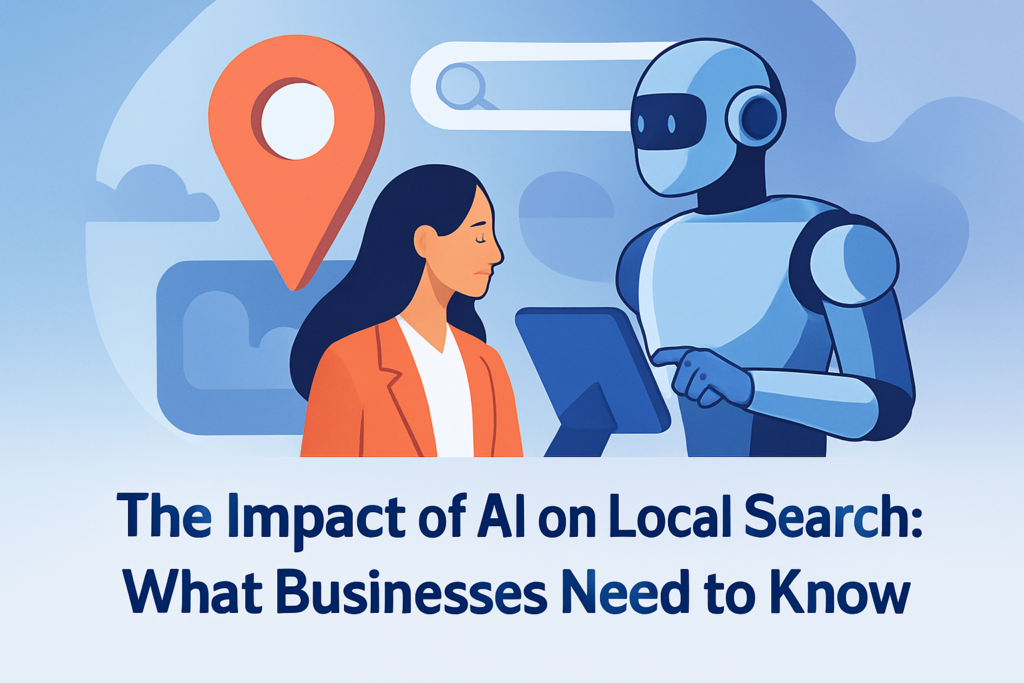
Local search is no longer just about ranking in the map pack or showing up for “near me” queries. Artificial intelligence now shapes how people discover businesses, compare options, and decide where to buy. For local companies, that shift changes what visibility means and how it must be measured.
The impact of AI on local search is practical, not theoretical. Searchers are asking longer questions, using voice assistants, relying on AI summaries, and turning to tools like ChatGPT, Gemini, and Perplexity for recommendations. Instead of scanning ten blue links, they often want one direct answer: the best dentist for anxious patients, the nearest emergency plumber open now, or a family-friendly restaurant with outdoor seating. AI systems try to synthesize that answer from many signals, including website content, reviews, structured data, business profiles, and third-party mentions.
Local search refers to the process of finding businesses, services, or locations tied to a geographic area. AI in local search refers to machine learning systems and generative engines that interpret intent, personalize results, summarize choices, and sometimes cite sources directly. Generative Engine Optimization, or GEO, is the practice of improving how a brand appears in AI-generated answers, not just traditional rankings. In my experience working with search visibility campaigns, local brands that understand this distinction adapt faster because they stop optimizing only for clicks and start optimizing for inclusion, citations, and trust.
This matters because AI compresses the decision journey. If your business is not clearly understood by machines, you may lose visibility before a user ever reaches your site. At the same time, AI creates opportunities for companies with strong local signals, useful content, and accurate first-party data. Affordable platforms like LSEO AI help businesses track AI visibility, monitor citations, and identify the prompts where they are appearing or being overlooked. That visibility is becoming as important as rank tracking was in the last era of SEO.
How AI is changing local search behavior
AI changes local search by improving intent matching. Google has used machine learning in local results for years, but generative interfaces raise the stakes. A user no longer needs to type “coffee shop Boston.” They can ask, “Where can I find a quiet coffee shop in Back Bay with strong Wi-Fi and seating for remote work?” AI parses multiple needs at once: location, ambiance, amenities, and purpose.
That means businesses must optimize for real-world attributes, not just category terms. If your listing says “cafe” but your reviews repeatedly mention laptop-friendly seating and fast internet, AI may infer relevance for remote workers. If your website never mentions those features, you make it harder for the system to trust and surface you consistently.
Voice search also matters. Spoken queries are longer and more conversational, and they often carry urgency. “Who is the best-rated pediatric urgent care near me open after 7 p.m.?” is not a keyword fragment. It is a complete decision request. AI thrives on that format, which is why local businesses need content that answers specific customer questions in plain language.
Personalization is another shift. AI can weigh context like location, time of day, device type, and prior behavior. A tourist searching for “best pizza nearby” may get a different set of suggestions than a local resident looking for takeout deals. Businesses cannot control every personalization factor, but they can control the consistency and clarity of the signals they publish across the web.
What signals AI uses to recommend local businesses
AI systems use a mix of structured and unstructured signals. The foundation still includes your Google Business Profile, NAP consistency, categories, hours, service areas, and proximity. But AI also evaluates website copy, review sentiment, FAQ language, schema markup, menus, appointment details, images, and third-party references.
Reviews are especially influential because they contain natural language. A hundred customers saying a salon is “great for curly hair” can become a strong entity association. A law firm described repeatedly as “responsive after car accidents” may earn visibility for a specific legal need, even if that exact phrase is not repeated across every page. AI extracts patterns from these comments and folds them into local relevance.
Business websites still matter deeply. Generative engines need corroboration. If your profile says you offer same-day HVAC repair, your site should support that claim with a dedicated service page, clear service hours, and location information. The strongest local brands create content that aligns across profile data, on-site pages, and off-site mentions.
| Signal | Why AI cares | Business action |
|---|---|---|
| Google Business Profile | Provides primary local facts and categories | Keep hours, services, photos, and attributes updated weekly |
| Reviews | Reveal sentiment, specialties, and trust | Request detailed reviews mentioning services and outcomes |
| Website content | Confirms expertise and service relevance | Build location and service pages with specific local details |
| Schema markup | Helps machines interpret business entities | Use LocalBusiness, FAQ, Review, and Service schema where appropriate |
| Third-party mentions | Support authority and citation consistency | Maintain accurate listings and earn local press or directory mentions |
Search engines and answer engines both favor consistency. When one source says you are open Sundays and another says closed, confidence drops. When your address varies across platforms, AI may hesitate to recommend you. Local visibility is increasingly a data quality problem as much as a ranking problem.
Why Google Business Profile is more important in the AI era
Google Business Profile remains the most influential local asset because it feeds maps, local packs, branded results, and many answer layers. In AI-assisted search, it functions as a trusted source of operational truth. If your profile is incomplete, outdated, or thin on supporting details, you reduce your chances of appearing for nuanced local intents.
The strongest profiles are not just claimed; they are actively managed. That means choosing precise categories, adding appointment or ordering links, uploading recent photos, publishing updates, monitoring Q&A, and validating service areas. For multilocation businesses, governance matters even more. I have seen brands lose local visibility simply because one location used a different naming convention or selected broad categories that diluted relevance.
Attributes have become strategic. Accessibility options, payment methods, outdoor seating, women-owned status, language support, and amenities can all map to conversational queries. If someone asks AI for a bilingual dentist with Saturday hours, those details matter. They are not decorative fields. They are machine-readable relevance signals.
Review management should also be operationalized. Encourage customers to describe their experience in specifics rather than generic praise. “Fast service” helps less than “fixed my leaking water heater the same day in downtown Tampa.” Specificity gives AI more confidence when matching your business to a prompt.
How to optimize your website for AI-driven local search
Start with service pages and location pages. Every core service should have its own page, and every priority market should have a page that reflects local reality. Avoid thin pages that swap city names. AI systems detect templated content quickly and trust it less. Useful location pages mention neighborhoods served, common customer problems in that area, response times, parking or visit details, testimonials, and FAQs.
Use schema markup to clarify entities and services. LocalBusiness schema, opening hours, sameAs links, geo coordinates, service areas, and FAQ schema all help machines understand your business. Schema will not compensate for weak content, but it improves interpretation when the underlying information is strong.
Write for questions, not just keywords. Add concise answers for common local prompts: Do you offer emergency service? Which insurance plans do you accept? Do you have wheelchair access? Can I book online? These questions mirror how people interact with AI tools. A concise answer paragraph can support both featured snippets and generative citations.
Technical SEO still matters. Slow mobile pages, broken internal links, and inaccessible navigation reduce crawl efficiency and user trust. For local businesses, mobile performance is critical because high-intent searches often happen on phones in real time. A site that loads quickly and presents contact information immediately supports both rankings and conversions.
Stop guessing what users are asking. Traditional keyword research is not enough for the conversational age. LSEO AI’s Prompt-Level Insights unearth the natural-language questions that trigger brand mentions, and just as importantly, the prompts where competitors appear instead. Try LSEO AI free for 7 days.
The role of reviews, reputation, and local authority
In local AI search, reputation is content. Reviews, ratings, testimonials, and local mentions help systems estimate quality and fit. Quantity still matters, but language matters more than many businesses realize. AI reads themes across reviews to understand specialties, strengths, and weaknesses.
If customers repeatedly mention long wait times, expensive pricing, or inconsistent communication, that can influence recommendations. Conversely, if they mention fast turnaround, compassionate staff, or child-friendly service, those traits can align you with high-intent prompts. This is why review generation should be paired with review analysis. Look for recurring descriptors and feed them back into your website copy, FAQs, and service messaging when accurate.
Local authority also extends beyond reviews. Mentions in chamber of commerce directories, local news, industry associations, and niche directories reinforce your legitimacy. Backlinks are still useful, but in AI-driven discovery, clean entity corroboration can be just as valuable. A restaurant cited by reputable local guides, a contractor listed by manufacturer partners, or a clinic referenced by regional associations sends strong trust signals.
If you need expert support, consider working with a specialist in Generative Engine Optimization. LSEO’s GEO services help brands strengthen visibility across AI-powered discovery, and LSEO was also named one of the top GEO agencies in the United States.
How businesses should measure AI visibility in local search
Traditional local SEO metrics like rankings, calls, direction requests, and click-through rates still matter, but they are no longer enough. Businesses also need to know whether AI engines mention them, cite them, or exclude them from recommendation sets entirely. That is the new visibility layer.
Measurement should include branded and non-branded prompts, competitor comparisons, citation frequency, and assisted traffic patterns. For example, if ChatGPT recommends three local accountants and your firm never appears, that is a discoverability problem even if your website ranks well in standard search. Likewise, if AI summaries cite your site but clicks decline, you may need to adjust content so it captures demand earlier in the journey.
Accuracy matters here. Many tools rely on estimates, scraped snapshots, or narrow prompt sets. A stronger approach combines AI visibility tracking with first-party analytics. Are you being cited or sidelined? LSEO AI tracks when and how your brand appears across the AI ecosystem, helping turn a black box into a usable map of authority. Get started with a 7-day free trial at LSEO.com/join-lseo/.
One advantage of LSEO AI is its focus on data integrity through integrations with Google Search Console and Google Analytics. That allows businesses to compare AI visibility with actual performance data rather than relying on assumptions. For local brands managing lean budgets, that level of accuracy matters because every optimization decision must connect to revenue, not vanity metrics.
What businesses should do next
AI is reshaping local search by turning scattered signals into direct recommendations. Businesses that win will be the ones that make themselves easy for machines to understand and easy for customers to trust. That means keeping Google Business Profile data accurate, building useful local content, implementing schema, generating detailed reviews, and tracking visibility beyond rankings alone.
The core lesson is simple: local SEO is no longer just about where you rank. It is about whether AI systems can confidently recommend your business for real customer needs. Companies that act now can build a durable advantage while competitors are still focused only on yesterday’s metrics.
If you want a practical way to monitor and improve your presence across AI search, explore LSEO AI. It gives business owners and marketers an affordable way to track citations, uncover prompt-level opportunities, and connect AI visibility to first-party performance data. In a local market where recommendation engines increasingly influence who gets chosen, that insight is no longer optional.
Frequently Asked Questions
How is AI changing local search for small and mid-sized businesses?
AI is changing local search by expanding how customers find and evaluate local businesses beyond traditional map listings and standard keyword searches. In the past, visibility often centered on ranking in the local pack, optimizing a Google Business Profile, and targeting phrases like “plumber near me” or “best dentist in [city].” Today, AI-driven search experiences interpret intent more deeply, summarize business information directly in search results, and help users compare options without clicking through the same way they once did. That means local businesses are no longer competing only for rankings. They are also competing for inclusion in AI-generated answers, voice assistant responses, and recommendation engines that pull information from multiple sources.
For small and mid-sized businesses, this shift is especially important because AI rewards clarity, consistency, and trust signals. A business with complete location data, strong reviews, accurate service descriptions, locally relevant website content, and a well-maintained online presence is more likely to be understood correctly by AI systems. These systems look for patterns that confirm legitimacy and relevance. If your address, hours, categories, services, and customer sentiment are inconsistent across platforms, your visibility can suffer even if your business is strong offline.
AI also changes customer behavior. Searchers are asking more specific, conversational questions such as “Who is the best family-friendly Italian restaurant open now with gluten-free options?” instead of typing short phrases. As a result, local SEO has become more about answering real customer questions than simply matching exact keywords. Businesses that create content around services, neighborhoods, common concerns, pricing expectations, and customer scenarios are better positioned to appear in these AI-informed discovery journeys.
What does visibility in local search mean now that AI summaries and assistants influence results?
Visibility in local search now means being present wherever a customer is making a decision, not just appearing in one set of rankings. AI summaries, voice assistants, and conversational search tools often pull together data from business listings, review platforms, websites, local directories, and third-party sources to generate recommendations. In practical terms, a business can be highly visible in traditional search but still miss opportunities if AI systems do not have enough reliable, structured, and relevant information to reference.
This broader definition of visibility includes being cited or described accurately in AI-generated overviews, surfacing in response to highly specific local questions, and standing out when users compare providers by reputation, services, convenience, and relevance. It also means your business information must be machine-readable as well as customer-friendly. Detailed service pages, FAQs, schema markup, current business hours, location-specific content, and consistent listings all help AI systems understand what your business offers and when it is the best fit for a given query.
Businesses should also rethink how they measure local search success. Rankings and impressions still matter, but they are no longer the full picture. It is increasingly important to track phone calls, direction requests, website leads, bookings, branded searches, review activity, and assisted conversions from multiple platforms. If AI helps a user narrow their options and your business gets the call, visit, or appointment, that is visibility with real business value. The key takeaway is that local visibility is becoming less about where you rank on one screen and more about how often your business is recommended, understood, and chosen across the entire search experience.
What should businesses do to optimize for AI-driven local search?
Businesses should start by strengthening the fundamentals, because AI tends to amplify businesses with accurate, complete, and trustworthy digital signals. First, make sure your Google Business Profile is fully optimized with correct categories, services, hours, photos, business description, attributes, and regular updates. Then confirm that your name, address, phone number, website, and operating details are consistent across directories, maps, review sites, and social platforms. AI systems rely on consistency to validate business identity and location relevance.
Next, improve your website so it clearly communicates who you serve, what you offer, and where you operate. Create dedicated location and service pages that answer real customer questions in natural language. Include content around neighborhoods, service areas, common problems, timelines, pricing factors, and trust-building proof such as testimonials and case studies. This helps AI connect your business to the longer, more nuanced queries people now use. Structured data is also important because schema markup can give search engines clearer signals about your organization, location, services, reviews, and FAQs.
Review strategy has become even more important in the AI era. Encourage customers to leave detailed, honest reviews that mention the service provided, location, timeliness, and overall experience. AI can analyze review themes, not just star ratings, so richer feedback helps your business appear more relevant for specific customer needs. Finally, monitor how your business appears across search, maps, AI tools, and industry platforms. Optimization for AI-driven local search is not about chasing one algorithm trick. It is about building a strong, verifiable, useful digital presence that both humans and machines can trust.
Are reviews and reputation more important because of AI in local search?
Yes, reviews and overall digital reputation are becoming even more influential because AI tools are designed to help users assess quality quickly. Instead of simply listing businesses in order, AI can summarize common review themes, highlight strengths and weaknesses, and compare providers based on customer sentiment. That means your reputation is no longer just a supporting factor for rankings. It is increasingly part of the recommendation itself. If customers consistently praise your responsiveness, cleanliness, value, expertise, or friendliness, those signals can help AI systems view your business as a strong match for related searches.
What matters most is not only the volume of reviews, but also their quality, recency, and specificity. A steady flow of recent reviews signals that the business is active and still delivering a reliable experience. Detailed reviews provide more context for AI systems to interpret, especially when users ask nuanced questions. For example, a searcher may want “a pediatric dentist who is good with anxious kids” or “a contractor known for clear communication and staying on budget.” Reviews that naturally include those qualities can improve how your business is understood in decision-making environments shaped by AI.
Businesses should also respond thoughtfully to reviews, both positive and negative. Responses show engagement, professionalism, and customer care, and they can reinforce important service details. In addition, reputation management now extends beyond major review sites. Mentions on social platforms, local publications, industry directories, and community forums all contribute to the digital footprint AI may use. The stronger and more consistent your reputation across channels, the more likely your business is to be recommended with confidence.
How can businesses measure the impact of AI on local search performance?
Measuring the impact of AI on local search performance requires a broader set of metrics than many businesses have traditionally used. Standard local SEO indicators such as map pack rankings, Google Business Profile views, and organic traffic still provide useful insight, but they do not fully capture how AI influences discovery and decision-making. Businesses should pay close attention to conversion-focused signals such as phone calls, form submissions, bookings, direction requests, chat inquiries, and in-store visits tied to local search activity. These actions reveal whether increased visibility is actually turning into business outcomes.
It is also useful to monitor the types of queries bringing people in. AI-driven search often produces longer, more conversational search behavior, so rising visibility for question-based or intent-rich searches can signal that your content and listings are aligned with current user behavior. Look for trends in branded searches, service-plus-location searches, and assisted conversions where users first discover you through search but convert later through another channel. Tracking review volume, review sentiment, and mention frequency across platforms can also help show whether your authority and relevance are improving in ways that AI systems may reward.
Finally, businesses should regularly test how they appear in real-world search experiences. Search your services using natural-language questions, voice queries, and comparison-style prompts. Check how your business is described in maps, search summaries, and third-party platforms. If you are frequently included, accurately represented, and selected by customers, your strategy is working. If not, the gap often points to weak content, incomplete business data, inconsistent citations, or insufficient reputation signals. In the AI era, measurement is not just about position. It is about discoverability, credibility, and conversion across the full local search journey.