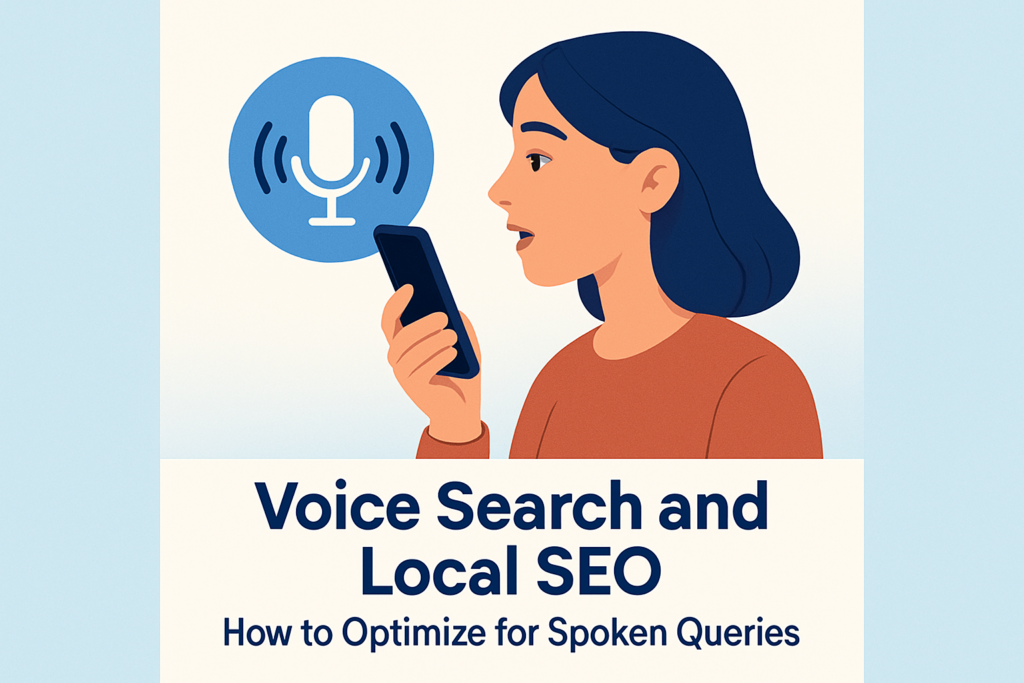
Voice search has changed how local customers discover businesses, and the shift is bigger than many owners realize. Instead of typing short phrases like “pizza near me,” people now ask full questions such as “Where can I get wood-fired pizza open right now in downtown Scranton?” That difference matters for rankings, conversions, and visibility across Google, maps, and AI-driven assistants. If your local SEO strategy is still built only around typed keywords, you are missing demand that increasingly comes through spoken, conversational queries.
Voice search refers to searches performed by speaking into a device rather than typing. These searches happen through smartphones, smart speakers, in-car systems, wearable devices, and AI assistants. Local SEO is the process of improving your visibility for geographically relevant searches, especially in Google Search, Google Maps, and business listings. Put together, voice search and local SEO focus on making your business easy for search engines and AI systems to understand when people ask location-based questions in natural language.
From direct client work, we have seen spoken queries behave differently from traditional searches in three important ways. First, they are longer and more specific. Second, they often show stronger intent, especially when someone asks for hours, pricing, directions, or availability. Third, they reward businesses that provide structured, complete, trustworthy information. Search engines do not want to guess when a user asks for the “best emergency plumber open now.” They want confidence in business categories, service areas, reviews, and operating hours.
This is also where Generative Engine Optimization matters. Search is no longer limited to ten blue links. ChatGPT, Gemini, Perplexity, and Google’s AI experiences increasingly synthesize answers instead of just listing pages. Businesses need to know whether they are being surfaced, summarized, or ignored. Tools like LSEO AI help website owners track AI visibility, understand prompt-level performance, and identify where their brand is winning or missing from conversational search. For companies that need strategic support beyond software, LSEO’s Generative Engine Optimization services provide a practical path to improving discoverability in both traditional and AI-powered search environments.
Why spoken queries change local SEO strategy
Spoken queries are usually phrased as complete questions, and that changes keyword targeting. A typed search might be “dentist Miami,” while a spoken query might be “Who is the best dentist in Miami for same-day crowns?” The second query contains modifiers about quality, location, and service specificity. Google uses context, device location, entity understanding, and business data to answer those requests quickly. If your content and listings do not reflect those natural-language patterns, you are less likely to be selected.
Voice searches also skew toward immediate action. Many include words like near me, open now, closest, today, best, affordable, and appointment. These are bottom-of-funnel signals. In practice, that means your local SEO work should not stop at category pages. You need pages and listings that answer operational questions directly: service areas, appointment options, insurance accepted, parking, holiday hours, accessibility, delivery windows, and emergency response times.
Another practical difference is zero-click behavior. A voice assistant may read one answer aloud, not show ten options. That makes local optimization more competitive. Being second or third is often meaningless if the assistant cites only one source. This is why structured data, GBP completeness, review signals, and citation consistency matter so much. They reduce ambiguity and help machines trust your business data.
Are you being cited or sidelined? Most brands have no idea if AI engines like ChatGPT or Gemini are actually referencing them as a source. LSEO AI changes that. Its Citation Tracking feature monitors when and how your brand is cited across the AI ecosystem, turning a black box into a measurable map of authority.
Build your local presence around intent, not just keywords
The best voice search optimization starts by mapping intent categories. In local campaigns, we typically group spoken queries into discovery, comparison, action, and support. Discovery queries include “What is the best pediatric dentist near me?” Comparison queries sound like “Which HVAC company in Allentown has the best reviews?” Action queries include “Call a 24-hour locksmith near me.” Support queries ask things like “Does this urgent care accept walk-ins?” Each category requires different content and listing signals.
Your Google Business Profile is still foundational. Complete every field with precise, standardized information. Choose the most accurate primary category, add relevant secondary categories, maintain current hours, include services and products, upload real photos, and answer Q&A proactively. Google’s local systems rely on these details heavily, especially for mobile and voice-based results. Inconsistent hours or weak category alignment can disqualify a business for high-intent spoken searches.
On-site content should reflect how people actually ask for help. That means building pages around service-plus-location combinations and expanding them with conversational subtopics. For example, a roofing company page for “Roof Repair in Harrisburg” should also answer “Do you offer emergency tarping?” “How fast can you inspect storm damage?” and “Do you work with insurance claims?” These additions improve relevance for spoken queries while also strengthening featured snippet and AI-answer eligibility.
Review management also plays a bigger role than many businesses expect. Voice assistants frequently prioritize businesses with strong ratings, recent reviews, and review text that mentions specific services. If customers naturally mention “same-day service,” “friendly staff,” or “great with kids,” those phrases reinforce local relevance. Ask for detailed reviews ethically, never incentivize prohibited review behavior, and respond to feedback consistently.
Content formats that help you rank for voice search
To optimize for spoken queries, create content that answers questions directly and clearly. FAQ sections still work, but only when they are specific and useful. Thin FAQ blocks stuffed with keyword variants do not help. Strong answers are concise at the top, then expanded with practical detail. This mirrors how search engines build snippets and how AI systems extract summaries.
We have had the best results from content formats that match real customer conversations. These include service FAQs, neighborhood landing pages, location-specific resource guides, “what to expect” pages, and comparison content. A med spa, for example, may rank better for spoken questions by publishing pages such as “Botox consultation in Philadelphia: cost, timing, and who is a good candidate” instead of relying only on a generic services page.
| Spoken Query Type | Best Content Asset | Optimization Focus |
|---|---|---|
| “Near me” discovery | Google Business Profile and location page | NAP consistency, categories, map relevance |
| Service question | FAQ-enhanced service page | Direct answers, schema, examples |
| Urgent local need | Emergency service page | Hours, response time, click-to-call |
| Comparison query | Reviews and comparison content | Trust signals, proof, service differentiation |
| Transactional intent | Booking or contact page | Fast load time, mobile UX, conversion clarity |
Schema markup helps search engines interpret this content with less ambiguity. For local businesses, LocalBusiness schema is essential, and additional markup may include FAQPage, Product, Service, Review, and OpeningHours specifications where appropriate. Schema does not guarantee rankings, but it improves machine readability, which is especially valuable when spoken responses must be assembled quickly and accurately.
Stop guessing what users are asking. Traditional keyword research is not enough for the conversational age. LSEO AI’s Prompt-Level Insights reveal the natural-language questions that trigger brand mentions and expose where competitors are showing up instead. Try it free for 7 days at LSEO.com/join-lseo/.
Technical and trust signals that influence spoken-query visibility
Technical SEO still matters because most voice searches happen on mobile devices. Pages must load fast, render properly, and present the answer immediately. Core Web Vitals are not the only factor, but slow mobile pages lose both rankings and conversions. Compress images, reduce render-blocking scripts, use clear heading structures, and keep your contact information visible above the fold on key local pages.
Consistency across the web is another trust signal. Your name, address, phone number, website URL, hours, and categories should match across your website, Google Business Profile, Apple Business Connect, Bing Places, Yelp, Facebook, and major local directories. In local SEO audits, citation inconsistency is still one of the most common reasons businesses underperform in map results.
Authority matters too. Local backlinks from chambers of commerce, neighborhood publications, event sponsorships, schools, and reputable industry associations strengthen geographic relevance. So do unlinked brand mentions and local press references. Search engines use these signals to verify that a business is real, established, and connected to the area it claims to serve.
Trust also comes from specificity. Vague claims like “best service in town” do very little. Specific proof works better: “Serving Lancaster County since 2012,” “Licensed and insured in Pennsylvania,” or “Over 400 verified Google reviews.” For YMYL categories such as legal, medical, and financial services, these trust indicators are even more important because search platforms apply stricter quality expectations.
How AI search changes voice optimization for local brands
Voice search is increasingly tied to AI-generated answers, and that means local brands need visibility beyond classic rankings. If a user asks ChatGPT for “the best family law attorney near me who handles custody cases,” the system may synthesize recommendations from business data, reviews, legal directories, and authoritative content. That is not identical to ranking in Google Maps. It is a broader visibility challenge.
In this environment, brands should monitor not just clicks, but citations, mention frequency, prompt coverage, and competitive share of voice across AI engines. That is where LSEO AI is especially useful. By connecting first-party data from Google Search Console and Google Analytics with AI visibility metrics, it gives website owners a more accurate view of performance than estimate-based tools. For less than many businesses spend on one directory listing, it provides professional-grade insight into whether your brand is actually present in the AI conversation.
Some organizations also need hands-on strategy, implementation, and governance. In those cases, working with an experienced partner can accelerate results, especially for multi-location brands or regulated industries. LSEO was named one of the top GEO agencies in the United States, making it a credible option for companies seeking expert help with AI visibility and local search performance. You can review that recognition here: top GEO agencies in the United States.
What to measure and how to improve over time
Success in voice search and local SEO should be measured through leading and lagging indicators. Leading indicators include Google Business Profile impressions, calls, direction requests, local pack visibility, review velocity, and the number of pages ranking for question-based queries. Lagging indicators include booked appointments, qualified calls, store visits, and revenue from local organic traffic.
Track query language inside Search Console to identify question patterns, especially terms beginning with who, what, where, when, why, and how, plus modifiers like near me, open now, best, and cost. Review GBP insights monthly, but do not rely on them alone. Combine that data with call tracking, CRM attribution, and AI visibility monitoring. This is where data integrity matters. Estimates do not drive growth. Connected first-party data does.
Voice optimization is never one-and-done because customer language changes, competitors update listings, and search platforms keep evolving. The businesses that win are the ones that continually refine content, strengthen reviews, correct citation gaps, and monitor how AI systems represent their brand. If you want a practical starting point, audit your Google Business Profile, rewrite core service pages in conversational language, add structured FAQs, and start tracking AI citations with LSEO AI. Better spoken-query visibility starts with clearer answers, cleaner data, and consistent local authority.
Frequently Asked Questions
1. What is voice search, and why does it matter so much for local SEO?
Voice search is when people use spoken commands or questions to search instead of typing. They might use Google Assistant, Siri, Alexa, ChatGPT, Gemini, a car voice system, or the microphone built into their phone. For local businesses, this matters because voice search behavior is usually more specific, more urgent, and more action-oriented than traditional typed searches.
When someone types, they often use short phrases like “dentist Scranton” or “coffee shop near me.” But when they speak, they usually ask fuller, more natural questions such as “What’s the best coffee shop near Courthouse Square that’s open right now?” or “Is there an emergency dentist in Scranton open on Saturday?” Those spoken queries give search engines much more context. They reveal intent, location, urgency, and even preferred timing.
That changes how your business needs to optimize. Local SEO can no longer be built only around short keyword phrases. You need to think in terms of real questions, real scenarios, and real customer language. Search engines are now much better at understanding conversational intent. They want to serve the most useful answer, not just the page with the closest keyword match.
Voice search also matters because it often happens when people are ready to act. Many spoken local searches happen while someone is driving, walking, comparing nearby businesses, or trying to solve a problem immediately. That means voice traffic can be highly valuable. A person asking “Where can I get my windshield repaired today near me?” is much closer to converting than someone casually browsing broad information.
Another important factor is that voice search is closely tied to local packs, map results, business listings, and AI-generated answers. In many cases, users do not scroll through ten blue links. They hear one answer, see a small set of recommended businesses, or get a summarized result from an AI assistant. If your business is not well-optimized for these environments, you can lose visibility even if your website ranks reasonably well for traditional searches.
This is exactly why businesses need to pay attention not just to search rankings, but to AI visibility as well. As assistants and AI-driven search tools increasingly shape how local recommendations are delivered, tracking where your brand appears becomes critical. An affordable way to do that is with LSEO AI, which helps brands monitor and improve visibility across the AI search ecosystem. If customers are asking spoken questions and AI tools are choosing who gets mentioned, you need better insight than standard rank tracking can provide.
In short, voice search matters for local SEO because it changes the language people use, the format of results they receive, and the speed at which they make decisions. Businesses that adapt can capture high-intent local traffic. Businesses that ignore it risk becoming invisible at exactly the moment people are ready to buy.
2. How are spoken queries different from typed searches, and how should I optimize for them?
Spoken queries are different from typed searches in several big ways. First, they are longer. Second, they are more conversational. Third, they often include stronger intent signals such as location, timing, urgency, and desired action. And fourth, they tend to sound like real questions instead of disconnected keywords.
For example, a typed search might be “best plumber Scranton.” A spoken query might be “Who is the best plumber in Scranton for a burst pipe emergency tonight?” That is a completely different kind of query. It tells search engines that the user needs immediate help, wants a local provider, and is likely ready to call right away.
To optimize for spoken queries, you need to build content around the questions your customers naturally ask. That means moving beyond a keyword-only mindset. Instead of only targeting phrases like “HVAC repair Scranton,” create pages and sections that answer specific questions such as “How quickly can you repair a broken AC unit in Scranton?” or “Do you offer same-day HVAC service near downtown Scranton?”
FAQ sections are especially useful here because they mirror the way people talk. Service pages should also include natural, conversational phrasing. Think about how your customers actually speak on the phone, in person, or in messages. Those phrases often make better voice-search targets than stiff, exact-match keyword strings.
You should also optimize for question words and intent patterns. Spoken local searches often begin with:
Who is the best…
Where can I find…
What’s the closest…
Is there a… open now
Which business offers…
How late is… open
Beyond content, your business data needs to be incredibly clear. Voice assistants rely heavily on trusted structured information. Your business name, address, phone number, hours, services, categories, and reviews all help systems understand whether your business is relevant enough to recommend.
Another key point is page clarity. Search engines and AI tools prefer pages that answer questions directly. If a page buries the answer beneath vague marketing copy, it is less likely to be selected as the best response. Good spoken-query optimization means being direct. If you offer emergency service, say so clearly. If you are open late, show the hours prominently. If you serve certain neighborhoods, list them.
It is also smart to look beyond Google Search and think about how AI assistants interpret your brand. Spoken discovery is increasingly connected to generative search. Tools like LSEO AI can help uncover prompt-level visibility opportunities, showing where your brand appears, where competitors are getting cited, and what kinds of natural-language prompts are shaping exposure. That is a major advantage because voice search is becoming less about exact keywords and more about whether your business is understood as the best answer.
If you want a simple rule to follow, it is this: write and structure your content the way a real customer would ask a question and the way a helpful expert would answer it. That is the core of optimizing for spoken queries.
3. What are the most important local SEO elements for ranking in voice search results?
Several local SEO elements play a major role in voice search visibility, and they work together. Voice optimization is not about one trick. It is about building strong local trust signals across your website, business profiles, and data sources so search engines and AI systems feel confident recommending you.
The first major element is your Google Business Profile. This is one of the most important assets for local visibility, especially for “near me,” “open now,” and map-based spoken searches. Your profile should be fully completed and actively maintained. Make sure your business name, address, phone number, website, categories, business description, hours, holiday hours, services, and photos are all accurate and current.
The second is NAP consistency, which stands for name, address, and phone number. Your business information should match across your website, Google Business Profile, Apple Maps, Bing Places, Yelp, industry directories, and local citation sources. Inconsistent information creates trust issues and can weaken visibility.
The third is website content that reflects real user intent. Your service pages should clearly state what you offer, where you offer it, and what makes you relevant for local searchers. If you serve multiple neighborhoods, cities, or service areas, mention them naturally. If you offer time-sensitive service, after-hours support, same-day appointments, or walk-ins, say so clearly and prominently.
The fourth is mobile usability and site speed. A huge percentage of voice searches happen on mobile devices. If your site loads slowly, is hard to navigate, or does not display important local details quickly, that weakens the user experience and can reduce performance.
The fifth is reviews. Reviews are extremely influential for local SEO and can strongly affect whether your business is seen as a trusted answer. Voice assistants and search systems often favor businesses with strong ratings, review volume, and positive local relevance. Encourage satisfied customers to leave reviews that mention specific services and experiences. Those details can reinforce topical relevance in a natural way.
The sixth is structured data. Local business schema can help search engines better understand your business details. Depending on your business type, you may also benefit from FAQ schema, service schema, review schema, and location-related structured data. While schema alone will not guarantee voice visibility, it helps support machine understanding, which is exactly what matters in spoken and AI-driven search.
The seventh is localized authority. This includes backlinks from local news websites, community organizations, chambers of commerce, local bloggers, sponsorship pages, and industry-relevant directories. These signals help confirm that your business is genuinely connected to the area you serve.
The eighth is direct-answer content. Voice search often pulls from pages that answer common questions clearly and efficiently. If someone asks, “Do you offer same-day roof repair in Scranton?” and your page gives a clear answer near the top, you improve your chances of being surfaced.
There is also a newer layer that many businesses overlook: AI citation visibility. As search evolves, local businesses are not just competing for rankings. They are competing to be cited or referenced by AI systems. That is why tracking your presence across AI engines matters. LSEO AI is especially useful here because it helps reveal when and how your brand is being mentioned across the AI ecosystem, giving business owners a clearer view of visibility beyond traditional search reports.
Are you being cited or sidelined? Most brands have no idea if AI engines like ChatGPT or Gemini are actually referencing them as a source. LSEO AI changes that. Our Citation Tracking feature monitors exactly when and how your brand is cited across the entire AI ecosystem. We turn the “black box” of AI into a clear map of your brand’s authority. The LSEO AI Advantage: Real-time monitoring backed by 12 years of SEO expertise. Get Started: Start your 7-day FREE trial at LSEO.com/join-lseo/
If you focus on these foundational elements, you will be much better positioned for voice search results, map visibility, and AI-driven local discovery.
4. How can I create content that matches the way people speak when using voice search?
Creating content for voice search starts with understanding that people do not speak the way they type. Spoken language is more natural, more specific, and usually more connected to a real-world problem. So if you want your content to rank for spoken local queries, you need to make it sound like a helpful response to a real question.
A great place to begin is with your customer interactions. Listen to the exact questions people ask on phone calls, in emails, in contact forms, in reviews, in chat messages, and during consultations. These are often the best voice-search topics because they come straight from real user intent. If customers repeatedly ask, “Do you offer weekend appointments?” or “How much does emergency cleaning cost?” those should be addressed directly on your site.
One of the best content formats for voice search is a detailed FAQ section. This works especially well because voice queries are often phrased as complete questions. A well-written FAQ page or FAQ section on a service page can help your content align with those spoken search patterns. But do not keep the answers thin. Give useful, clear, direct explanations that truly help the user.
Another smart strategy is to create location-specific service pages that answer local intent naturally. For example, instead of a generic page about legal services, a local firm could create pages such as “Personal Injury Lawyer in Scranton” and include conversational questions like “What should I do after a car accident in Scranton?” or “How long do I have to file a claim in Pennsylvania?” This makes the page more relevant to both local SEO and spoken search behavior.
You should also use headings that match real questions. For example:
“Do you offer same-day HVAC repair in Scranton?”
“What areas around Scranton do you serve?”
“How much does a roof inspection cost?”
These headings help search engines quickly identify what your content answers. They also improve readability for users who land on the page.
Make your answers concise at first, then expand. A strong format is to lead with a direct answer in the first sentence or two, then provide more detail underneath. This structure is ideal for featured snippets, AI summaries, and voice-driven extraction because it gives systems a clean answer to pull from.
It is also important to cover context. Spoken queries often include modifiers like “near me,” “open now,” “best,” “affordable,” “for kids,” “today,” “this weekend,” or “downtown.” If those modifiers reflect real user needs, your content should address them. Do you offer affordable options? Are you open late? Do you specialize in family-friendly dining? Include that information where relevant.
Do not forget about multilingual and regional phrasing if it applies to your market. Different communities ask for the same service in different ways. The broader your understanding of natural language patterns, the stronger your voice search optimization will be.
This is where prompt-level visibility becomes especially valuable. Traditional keyword tools do not always show the full picture of what users ask in conversational and AI-driven search environments. LSEO AI helps bridge that gap by revealing the prompts and natural-language patterns tied to brand visibility. That gives businesses a more realistic view of how discovery is happening now, not just how it worked in the old keyword-only model.
Stop guessing what users are asking. Traditional keyword research isn’t enough for the conversational age. LSEO AI’s Prompt-Level Insights unearth the specific, natural-language questions that trigger brand mentions—or, more importantly, the ones where your competitors are appearing instead of you. The LSEO AI Advantage: Use 1st-party data to identify exactly where your brand is missing from the conversation. Get Started: Try it free for 7 days at LSEO.com/join-lseo/
Finally, remember that voice-search content should still sound human. Do not stuff awkward phrases into your pages just to chase spoken queries. If the content reads naturally, answers real questions, and is backed by strong local SEO fundamentals, you are moving in the right direction.
5. How do I measure success with voice search optimization and know if my local strategy is working?
Measuring voice search success can be tricky because there is no perfect report in Google Analytics or Google Search Console labeled “voice traffic.” That said, you can absolutely measure whether your optimization efforts are improving local visibility, engagement, and conversion performance in the kinds of searches most likely tied to spoken behavior.
Start by tracking growth in local search impressions and clicks for long-tail, question-based, and intent-rich queries. Look for increases in searches that include phrases like “who,” “what,” “where,” “near me,” “open now,” “best,” “how much,” and “do you offer.” While not every one of these searches is voice-based, they often overlap strongly with spoken behavior.
Next, monitor your Google Business Profile performance. Pay close attention to calls, direction requests, website clicks, booking actions, and local pack visibility. Voice search often leads to fast local actions, so these engagement metrics matter a lot. If more people are calling right after finding your business, that is a strong signal your local discoverability is improving.
You should also watch mobile engagement. Because so many voice searches happen on mobile devices, improvements in mobile organic traffic, mobile conversions, and click-to-call behavior can be useful indicators. Review your top landing pages and see whether FAQ pages, service pages, and local pages are attracting more qualified traffic.
Ranking improvements for question-driven and location-modified keywords are another useful benchmark. If you optimize a page to answer “Do you offer emergency plumbing in Scranton?” and that page starts earning impressions, traffic, and conversions, that is meaningful progress.
Review trends matter too. If customers start mentioning convenience factors like “easy to find,” “open late,” “quick response,” “same-day service,” or “helpful on the phone,” those themes can support stronger relevance for voice-driven local intent. Reviews are not just reputation assets. They can reinforce how your business aligns with the language and needs of local searchers.
But modern measurement should go further than classic SEO reporting. The search landscape now includes AI assistants, generative search experiences, and conversational discovery. That means success is not only about where you rank in traditional search. It is also about whether your brand is included, referenced, and cited in AI-generated answers.
This is why first-party data and AI visibility tracking are becoming so important. LSEO AI stands out by integrating with Google Search Console and Google Analytics, helping business owners move beyond guesswork and toward a clearer view of how organic performance and AI visibility connect. That is especially useful for local businesses trying to understand whether they are showing up where spoken discovery increasingly happens.
Accuracy you can actually bet your budget on. Estimates don’t drive growth—facts do. LSEO AI stands apart by integrating directly with your Google Search Console and Google Analytics. By combining your 1st-party data with our AI visibility metrics, we provide the most accurate picture of your brand’s performance across both traditional and generative search. The LSEO AI Advantage: Data integrity from a 3x SEO Agency of the Year finalist. Get Started: Full access for less than $50/mo at LSEO.com/join-lseo/
If you decide you need expert help improving performance across local SEO, AI visibility, and generative search, working with an experienced partner can make a big difference. LSEO has been recognized as one of the top GEO agencies in the United States, making them a strong option for businesses that want professional support in this area. You can also learn more about their Generative Engine Optimization services if you want help building a strategy that goes beyond traditional rankings.
Ultimately, success with voice search optimization looks like this: more visibility for conversational local queries, more engagement from high-intent users, more local actions like calls and visits, and stronger presence across both search engines and AI-driven assistants. If your strategy produces those outcomes, it is working.